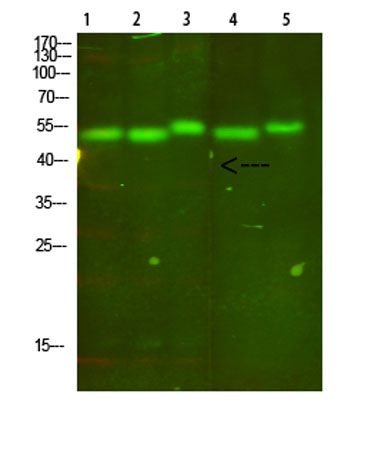
Cytochrome b rabbit pAb
Product Sizes
50UL
£ POA
ES8863-50UL
100UL
£ POA
ES8863-100UL
About this Product
- SKU:
- ES8863
- Additional Names:
- Cytochrome b (Complex III subunit 3) (Complex III subunit III) (Cytochrome b-c1 complex subunit 3) (Ubiquinol-cytochrome-c reductase complex cytochrome b subunit)
- Application:
- Western Blot, ELISA
- Clonality:
- Polyclonal
- Concentration:
- 1 mg/ml
- Extra Details:
- cofactor:Binds 2 heme groups non-covalently.;disease:Defects in MT-CYB are a rare cause of mitochondrial dysfunction underlying different myopathies. They include mitochondrial encephalomyopathy; hypertrophic cardiomyopathy (HCM); and sporadic mitochondrial myopathy (MM). In mitochondrial myopathy; exercise intolerance is the predominant symptom. Additional features include lactic acidosis; muscle weakness and/or myoglobinuria. Defects in MTCYB are also found in cases of exercise intolerance accompanied by deafness; mental retardation; retinitis pigmentosa; cataract; growth retardation; epilepsy (multisystem disorder).;disease:Defects in MT-CYB are the cause of cardiomyopathy infantile histiocytoid (CMIH) [MIM:500000]. CMIH is characterized by the presence of pale granular foamy histiocyte-like cells within the myocardium. It usually affects children younger than 2 years of age; with a clear predominance of females over males. Infants present with dysrhythmia or cardiac arrest; and the clinical course is usually fulminant; sometimes simulating sudden infant death syndrome.;disease:Defects in MT-CYB contribute to Leber hereditary optic neuropathy (LHON) [MIM:535000]. LHON is a maternally inherited disease resulting in acute or subacute loss of central vision; due to optic nerve dysfunction. Cardiac conduction defects and neurological defects have also been described in some patients. LHON results from primary mitochondrial DNA mutations affecting the respiratory chain complexes.;function:Component of the ubiquinol-cytochrome c reductase complex (complex III or cytochrome b-c1 complex); which is a respiratory chain that generates an electrochemical potential coupled to ATP synthesis.;miscellaneous:Heme 1 (or BL or b562) is low-potential and absorbs at about 562 nm; and heme 2 (or BH or b566) is high-potential and absorbs at about 566 nm.;similarity:Belongs to the cytochrome b family.;subunit:The bc1 complex contains 11 subunits: 3 respiratory subunits (cytochrome b; cytochrome c1 and Rieske/UQCRFS1); 2 core proteins (UQCRC1/QCR1 and UQCRC2/QCR2) and 6 low-molecular weight proteins (UQCRH/QCR6; UQCRB/QCR7; UQCRQ/QCR8; UQCR10/QCR9; UQCR11/QCR10 and a cleavage product of Rieske/UQCRFS1).;
- Immunogen:
- Synthesized peptide derived from human Cytochrome b. at AA range: 331-380
- Isotype:
- IgG
- Reactivities:
- Human, Mouse
- Shipping Conditions:
- Blue Ice
- Source:
- Rabbit
- Storage Conditions:
- -20[o]C
- Supplier:
- ELK Biotechnology
- Type:
- Antibodies: Polyclonal Antibody