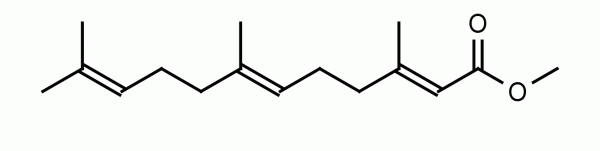
(E,E)-Methyl Farnesoate
Product Sizes
10 mg
£245.00
ECH-S-0153-10MG
100 mg
£1429.00
ECH-S-0153-100MG
About this Product
- SKU:
- ECH-S-0153
- Extra Details:
- Methyl farnesoate (MF) is a crustacean reproductive hormone that is structurally similar to insect juvenile hormone. It is responsible for enhancing reproductive maturation, maintaining juvenile morphology, and influencing male sex determination. Exposure of female Daphnids to increasing levels of MF increases the percentage of males in a brood in a dose-dependant manner. MF is endogenously produced in the mandibular organ and environmental factors such as salinity and temperature can influence hemolyph levels. \n \n \n \nStorage \n-20°C or below \nFeatured in Publications \n1) Olmstead, A. W. and G. A. LeBlanc (2007). "The environmental-endocrine basis of gynandromorphism (intersex) in a crustacean." Int J Biol Sci 3(2): 77-84. \n2) Eads, B. D., J. Andrews, et al. (2007). "Ecological genomics in Daphnia: stress responses and environmental sex determination." Heredity 100(2): 184. \n3) Nagaraju, G. P. C. and D. W. Borst (2008). "Methyl farnesoate couples environmental changes to testicular development in the crab Carcinus maenas." Journal of Experimental Biology 211(17): 2773-2778. \n4) P. Liu, H.-J. Peng and J. Zhu. (2015) Juvenile hormone-activated phospholipase C pathway enhances transcriptional activation by the methoprene-tolerant protein. In. Proceedings of the National Academy of Sciences USA 10.1073/pnas.1423204112 \n5) S. Schenk, et al. "Discovery of methylfarnesoate as the annelid brain hormone reveals an ancient role of sesquiterpenoids in reproduction" eLife 2016;5:e17126. DOI: 10.7554/eLife.17126 \n \nKeywords: Methyl (2E,6E)-3,7,11-trimethyldodeca-2,6,10-trienoate \n \n \n \nDocuments \nTechnical Data Sheet, Echelon
- Shipping Conditions:
- Blue Ice
- Storage Conditions:
- Please refer to datasheet
- Supplier:
- Echelon Biosciences
- Type:
- Proteins, Peptides, Small Molecules & Other Biomolecules: Small Molecules