PI4-Kinase beta (PI4Kb), active
Product Sizes
5 ug
£510.00
ECH-P32-102G-5UG
10 ug
£685.00
ECH-P32-102G-10UG
About this Product
- SKU:
- ECH-P32-102G
- Application:
- Detection/Quantitation, Western Blot
- Extra Details:
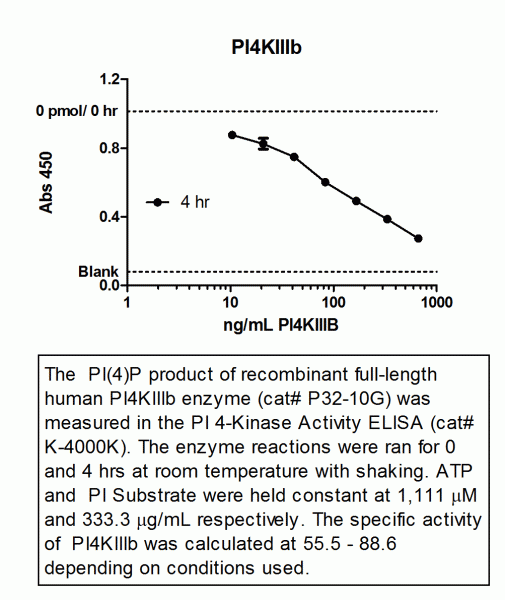
- PI4-Kinase beta (PI4Kb), active is a full-length, recombinant human PI4KB co-expressed by baculovirus in Sf9 insect cells using an N-terminal GST tag. Enzyme obtained from SignalChem. \n \nMolecular weight: ~120 kDa \nSequence: Full length \nSpecies: Human \nTag: GST tag \nPurity: >90 % (request TDS for lot specific information) \nSpecific Activity: >30 nmol/min/mg (request TDS for lot specific information) \nExpression System: Sf9 insect cells using baculovirus \nGenebank Number: BC000029 \nApplications: PI 4-Kinase assay , western blot. \nFormulation: Recombinant protein stored in 50 mM Tris-HCl, pH 7.5, 150 mM NaCl, 10 mM glutathione, 0.1 mM EDTA, 0.25 mM DTT, 0.1 mM PMSF, 25% glycerol. \nStorage and stability: Store product at -70C. Stable up to one year. \n \n \n \nProduct Background \n \nPI4KB is a member of the phosphatidylinositol 4-kinase family (PI4K) and is the first committed step in the production of the second messenger inositol-1,4,5-trisphosphate (PIP3). PI4KB regulates the golgi disintegration/reorganization during mitosis possibly via the phosphorylation of phosphatidylinositol. PI4KB is a type III enzyme that is sensitive to wortmannin and is responsible for regulating the synthesis of agonist-sensitive pools of polyphosphoinositides. PI4KB is critical for glucose-induced insulin secretion due to its capacity to regulate the release of secretory granules. PI4KB inhibits the insulin-stimulated translocation of glucose transporter-4 in mouse adipocytes through its interaction with neuronal calcium sensor. \n \n, Echelon
- Shipping Conditions:
- Dry Ice
- Storage Conditions:
- -20[o]C
- Supplier:
- Echelon Biosciences
- Type:
- Proteins, Peptides, Small Molecules & Other Biomolecules: Enzymes
- Manufacturer's Data Sheet:https://www.echelon-inc.com/product/pi4-kinase-beta-pi4kb-active/