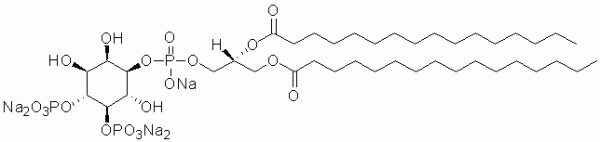
PI(4,5)P2 diC16
Product Sizes
100 ug
£207.00
ECH-P-4516-100UG
500 ug
£519.00
ECH-P-4516-500UG
1 mg
£830.00
ECH-P-4516-1MG
About this Product
- SKU:
- ECH-P-4516
- Extra Details:
- Phosphatidylinositol 4,5-bisphosphate diC16 (PI(4,5)P2 diC16) is a synthetic, purified dipalmitoyl PI(4,5)P2. \n \nPhosphoinositides (PIPns) are minor components of cellular membranes but are integral signaling molecules for cellular communication. Phosphatidylinositol 4,5-bisphosphate (PIP2) has been shown to play a central role in a variety of cellular functions. Amongst its many functions, PIP2 is a substrate for Phospholipase C-coupled G-protein pathways involved in intracellular calcium release in a number of tissues and is also a substrate for class I phosphoinositide 3-kinase (PI3-K). \n \n \n \nFeatured in Publications \n1) Hodgkin, M. N., M. R. Masson, et al. (2000). "Phospholipase D regulation and localisation is dependent upon a phosphatidylinositol 4,5-biphosphate-specific PH domain." Curr Biol 10(1): 43-6. \n2) Ozaki, S., D. B. DeWald, et al. (2000). "Intracellular delivery of phosphoinositides and inositol phosphates using polyamine carriers." Proc Natl Acad Sci U S A 97(21): 11286-11291. \n3) Gwanyanya, A., K. R. Sipido, et al. (2006). "ATP and PIP2 dependence of the magnesium-inhibited, TRPM7-like cation channel in cardiac myocytes." Am J Physiol Cell Physiol 291(4): C627-35. \n4) Liu, Z., T. Klaavuniemi, et al. (2011). "Distinct roles of four gelsolin-like domains of Caenorhabditis elegans gelsolin-like protein-1 in actin filament severing, barbed end capping, and phosphoinositide binding." Biochemistry 49(20): 4349-60. \n \nAlternate Names: Dipalmitoyl Phosphatidylinositol 4,5-bisphosphate, PtdIns(4,5)P2 (16:0/16:0), PI(4,5)P2 C16, or PIP2 \n \nBulk discounts available, please email echelon@echelon-inc.com for information. \n \n \n \nDocuments \nTechnical Data Sheet, Echelon
- Shipping Conditions:
- Dry Ice
- Storage Conditions:
- Please refer to datasheet
- Supplier:
- Echelon Biosciences
- Type:
- Proteins, Peptides, Small Molecules & Other Biomolecules: Small Molecules