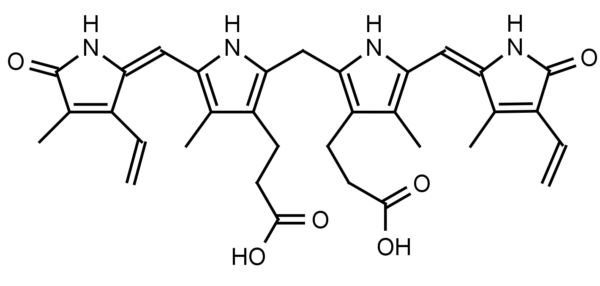
Bilirubin
Product Sizes
1 g
£647.00
ECH-F-H120-1G
About this Product
- SKU:
- ECH-F-H120
- Extra Details:
- Bilirubin is a water insoluble tetrapyrrole produced from the reduction of biliverdin in a reaction catalyzed by the enzyme bilirverdin reductase. In vivo it undergoes glucuronidation in the liver (addition of one or two glucuronic acids through a glycosidic bond) to form the water soluble mono or diglucuronide (also called bilirubin conjugate). The conjugate is excreted from the liver in bile or is converted to urobilinogen and excreted in the urine as urobilin or in the feces as stercobilin. \n \n \n \nStorage \nBilirubin is stable for at least one year when stored as a solid, protected from moisture, at -20 °C. Protect from light. \nReferences \n1) Lee, K. S., L. D. Raymond, et al. (2007). "Hemin Interactions and Alterations of the Subcellular Localization of Prion Protein." Journal of Biological Chemistry 282(50): 36525-36533. \n2) Soares, M. P., M. P. Seldon, et al. (2004). "Heme Oxygenase-1 Modulates the Expression of Adhesion Molecules Associated with Endothelial Cell Activation." The Journal of Immunology 172(6): 3553-3563. \n3) Huber, A. H., B. Zhu, et al. (2012). "Fluorescence Sensor for the Quantification of Unbound Bilirubin Concentrations." Clinical Chemistry 58(5): 869-876. \n4) Kirkby, K., C. Baylis, et al. (2007). "Intravenous bilirubin provides incomplete protection against renal ischemia-reperfusion injury in vivo." American Journal of Physiology - Renal Physiology 292(2): F888-F894. \n5) Wu, J., J. Ma, et al. (2005). "Bilirubin derived from heme degradation suppresses MHC class II expression in endothelial cells." Biochemical and Biophysical Research Communications 338(2): 890. \n \n \n \nDocuments \nTechnical Data Sheet, Echelon
- Shipping Conditions:
- Blue Ice
- Storage Conditions:
- Please refer to datasheet
- Supplier:
- Echelon Biosciences
- Type:
- Proteins, Peptides, Small Molecules & Other Biomolecules: Small Molecules