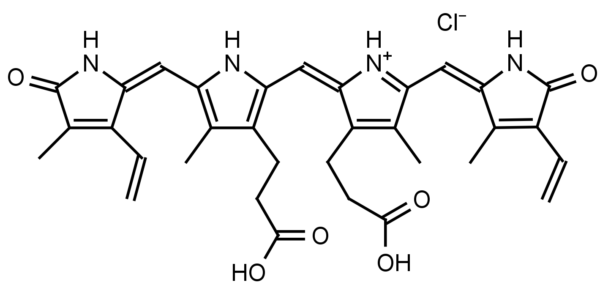
Biliverdin Hydrochloride
Product Sizes
100 mg
£469.00
ECH-F-H100-100MG
About this Product
- SKU:
- ECH-F-H100
- Extra Details:
- Biliverdin Hydrochloride is produced from the oxidation of heme in a reaction catalyzed by the enzyme heme oxygenase. Heme oxygenase has been implicated in tumor cell resistance to chemotherapy, reduction of free radical formation, reduction of inflammation, and has been associated with vascular repair. In vivo, biliverdin is reduced to bilirubin. Biliverdin Hydrochloride is soluble in basic aqueous solutions (pH > 9 for intitial dissolution) and soluble down to pH 7 once in solution as well as methanol and ethanol if made slightly basic. \n \n \n \nStorage \nBiliverdin Hydrochloride is stable for at least one year when stored as a solid, protected from moisture, at -20 °C. Protect from light. \nReferences \n1) Seta, F., L. Bellner, et al. (2006). "Heme Oxygenase-2 Is a Critical Determinant for Execution of an Acute Inflammatory and Reparative Response." The American Journal of Pathology 169(5): 1612. \n2) Jozkowicz, A., H. Was, et al. (2007). "Heme oxygenase-1 in tumors: is it a false friend?" Antioxid Redox Signal 9(12): 2099-117. \n3) Abraham, N. G. and A. Kappas (2005). "Heme oxygenase and the cardiovascular-renal system." Free Radic Biol Med 39(1): 1-25. \n4) Kim, D. H., A. P. Burgess, et al. (2008). "Heme oxygenase-mediated increases in adiponectin decrease fat content and inflammatory cytokines tumor necrosis factor-alpha and interleukin-6 in Zucker rats and reduce adipogenesis in human mesenchymal stem cells." J Pharmacol Exp Ther 325(3): 833-40. \n5) Overhaus, M., B. A. Moore, et al. (2006). "Biliverdin protects against polymicrobial sepsis by modulating inflammatory mediators." American Journal of Physiology - Gastrointestinal and Liver Physiology 290(4): G695-G703. \n6) MacLean, P. D., E. C. Drake, et al. (2007). "Bilirubin as an antioxidant in micelles and lipid bilayers: Its contribution to the total antioxidant capacity of human blood plasma." Free Radical Biology and Medicine 43(4): 600. \n \n \n \nDocuments \nTechnical Data Sheet, Echelon
- Shipping Conditions:
- Blue Ice
- Storage Conditions:
- Please refer to datasheet
- Supplier:
- Echelon Biosciences
- Type:
- Proteins, Peptides, Small Molecules & Other Biomolecules: Small Molecules