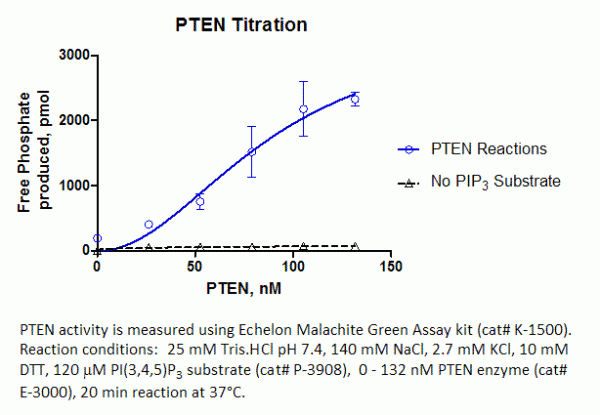
PTEN Enzyme, active
Product Sizes
2.5 ug
£221.00
ECH-E-3000-2.5UG
10 ug
£354.00
ECH-E-3000-10UG
About this Product
- SKU:
- ECH-E-3000
- Clonality:
- Recombinant Monoclonal
- Extra Details:
- PTEN Enzyme, active is a N-Terminal GST-Tagged, recombinent human PTEN (Phosphatase and Tensin Homolog), 76kD, purified from E.coli using glutathione-sepharose column chromatography. \n \nStorage: Store product > -70 C. Enzyme is stable for at least 6 months at -70 C as undiluted stock \nSpecificity: PTEN selectively removes phosphate from the 3' position of the inositol ring of PtdIns(3,4,5)P3 \nSpecific Activity: request Certificate of Analysis (COA) \n \n \n \nProduct Description \n \nThe PTEN enzyme is a 3-phosphoinositide phosphatase that converts PI(3,4,5)P3 to PI(4,5)P2; thus opposing PKB/Akt activation by PI3-K. PTEN is involved in neuronal stem cell proliferation and self-renewal, cardiac myocyte hypertrophy and contractility, and a wide range of developmental processes. PTEN, however, is best known for its role as a tumor suppressor. Loss of PTEN activity results in accumulation of PI(3,4,5)P3, abnormal activation of PKB/Akt, unregulated cell growth, suppression of apoptosis, and increase tumorigenesis in a number of human tissues. It has also been proposed that PTEN is a candidate for targeted chemotherapy because certain anti-cancer agents preferentially destroy tumors with PTEN mutations. In addition to this direct role in cancer, PTEN also indirectly regulates cancer-associated pathways including VEGF-mediated angiogenesis among others. \n \nReferences \n1. Brooks, R., et al. (2010). "SHIP1 inhibition increases immunoregulatory capacity and triggers apoptosis of hematopoietic cancer cells." J Immunol 184(7): 3582-3589. \n2. Caromile, L. A., et al. (2010). "The neurosecretory vesicle protein phogrin functions as a phosphatidylinositol phosphatase to regulate insulin secretion." J Biol Chem 285(14): 10487-10496. \n3. Thakral, C., et al. (2012). "ALK+ anaplastic large cell lymphoma exhibits phosphatidylinositol-3 kinase/akt activity with retained but inactivated PTEN-A report from the Children's Oncology Group." Pediatric Blood & Cancer 59(3): 440-447. \n4. Steidle, E. A., et al. (2016). "A novel inositol pyrophosphate phosphatase in Saccharomyces cerevisiae: Siw14 selectively cleaves the b-phosphate from 5-diphosphoinositol pentakisphosphate (5PP-IP5)." J. Biol. Chem. 291: 6772-6783. \n5. Alsina-Sanchis, E., et al. (2018). "ALK1 Loss Results in Vascular Hyperplasia in Mice and Humans Through PI3K Activation." Arteriosclerosis, thrombosis, and vascular biology 38(5): 1216-1229. \n \n \n \nDocuments \n \nTechnical Data Sheet, Echelon
- Shipping Conditions:
- Dry Ice
- Storage Conditions:
- -70[o]C
- Supplier:
- Echelon Biosciences
- Type:
- Proteins, Peptides, Small Molecules & Other Biomolecules: Enzymes