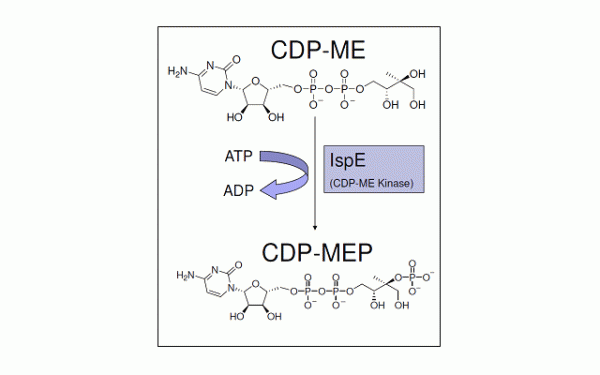
CDP-ME Kinase (IspE)
Product Sizes
20 ug
£414.00
ECH-E-2000E-20UG
80 ug
£612.00
ECH-E-2000E-80UG
About this Product
- SKU:
- ECH-E-2000E
- Extra Details:
- Recombinant 4-diphosphocytidyl-2-C-methyl-D-erythritol (CDP-MEP) kinase (IspE) with an C-terminal His-tag, purified from E.coli using Ni-NTA column chromatography. \n \n \n \nThe methylerythritol phosphate (MEP) pathway is used by most bacteria, including all Gram-negative bacteria, for isoprenoid biosynthesis. Isoprenoids comprise one of the most diverse classes of compounds found in nature. With over 50,000 different isoprenoids identified to date, they exhibit a broad range of structural complexity and are involved in a variety of biological functions [1]. Electron transport (quinones), stabilization of cell membranes (hopanoids and sterols), cell wall biosynthesis (dolichols), signal transduction (prenylated proteins), photosynthesis (chlorophylls) and modification of tRNAs are among the processes that involve isoprenoids [2]. Isopentenyl diphosphate (IPP) and dimethylallyl diphosphate (DMAPP) are the precursors for all isoprenoid compounds and two unrelated essential pathways exist in nature for their biosynthesis. These two precursors are produced by either the mevalonate (MVA) or MEP pathway. The MVA pathway is found primarily in eukaryotes and archea, including humans, plant cytosol and some Gram-positive bacteria, while the MEP pathway is utilized by most bacteria, including all Gram-negatives, and plant chloroplasts. Due to this natural distribution, the MEP pathway represents a promising target for development of novel antibacterial agents and herbicides [3]. \nIn the fourth step of the MEP pathway, 4-diphosphocytidyl-2-C-methyl-D-erythritol (CDP-ME) is converted to 4-diphosphocytidyl-2-C-methyl-D-erythritol-2-phosphate (CDP-MEP) by CDP-ME kinase (IspE) in an ATP dependent reaction. The formation of CDP-MEP occurs at a 1:1 ratio with the consumption of ATP. By measuring this decrease in ATP levels the user can infer the amount of CDP-MEP generated and monitor the activity of IspE. \nStorage \nStore product frozen below -20°C. Enzyme will be stable for at least 6 months at -20°C as undiluted stock. Freeze in working aliquots to avoid repeated thawing and freezing \nReferences \n1) Bochar, D.A.; Freisen, J.A.; Stauffacher, C.V. and Rodwell, V.W.(1999) in Comprehensive Natural Products Chemistry, (Cane, D. Ed.) Pergamon Press, Oxford, pp. 15-44. \n2) Sacchettini, J.C. and Poulter, C.C. (1997) Science, 277(5333), 1788-9. \n3) Testa, C.A.; Brown, M.J. (2003) Current Pharmceutical Biotechnology, 4, 248-259. \n \n \n \nDocuments \nTechnical Data Sheet, Echelon
- Shipping Conditions:
- Dry Ice
- Storage Conditions:
- -70[o]C
- Supplier:
- Echelon Biosciences
- Type:
- Proteins, Peptides, Small Molecules & Other Biomolecules: Enzymes