SHIP2 Lipid Phosphatase Enzyme, active
Product Sizes
10 ug
£769.00
ECH-E-1000-10UG
100 ug
£4111.00
ECH-E-1000-100UG
About this Product
- SKU:
- ECH-E-1000
- Extra Details:
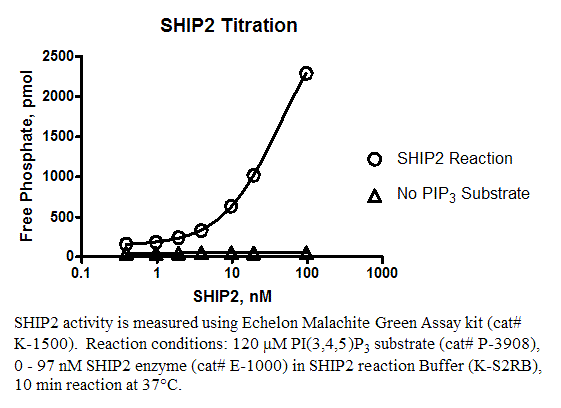
- N-terminal His-tagged, recombinant human SHIP2 (truncated form containing SH2 domain and inositol 5-phophatase catalytic domain) \n \nStorage: Store product > -70 C. Enzyme is stable for at least 6 months at -70 C as undiluted stock \nSpecificity: SHIP2 selectively removes the phosphate from the 5' position of the inositol ring of PtdIns(3,4,5)P3 \nMolecular Weight: 103 kDa \nSpecific Activity: request Certificate of Analysis (COA) \n \n \n \nProduct Description: \n \nThis His-tagged, recombinant human SHIP2 (truncated form containing SH2 domain and inositol 5-phophatase catalytic domain) is tested for activity against PIP3 and is purified from E.coli using Ni-NTA column chromatography. \n \nSH2-containing 5`-inositol phosphatase 2 (SHIP2) is a lipid phosphatase which converts PI(3,4,5)P3 to PI(3,4)P2. This negative regulation of insulin signaling has a fundamental impact on insulin resistance. SHIP2 down-regulates insulin signaling and is present at higher levels in diabetes and obesity. Abnormalities in SHIP function are increasingly linked to disease, in particular in the role of SHIP as a negative regulator of cytokine and immune receptor signaling. \n \nFeatured in Publications: \n \n1. Drees, B. E., A. Weipert, et al. (2003). "Competitive fluorescence polarization assays for the detection of phosphoinositide kinase and phosphatase activity." Comb Chem High Throughput Screen 6(4): 321-30. \n2. Brooks, R., G. M. Fuhler, et al. (2010). "SHIP1 inhibition increases immunoregulatory capacity and triggers apoptosis of hematopoietic cancer cells." J Immunol 184(7): 3582-9. \n3. Fuhler, G. M. B., R, Toms, Iyer, Geno (2012). "Therapeutic potential of SHIP1 and SHIP2 inhibition in cancer cells." Molecular Medicine 18: 65-75. \n4. Agollah, G. D., et al. (2014). "Evidence for SH2 Domain-Containing 5a²-Inositol Phosphatase-2 (SHIP2) Contributing to a Lymphatic Dysfunction." PLoS ONE 9(11): e112548. \n5. Proctor, A., et al. (2017). "Chemical fixation to arrest phospholipid signaling for chemical cytometry." Journal of Chromatography A 1523(10): 97-106. \n6. Willett, R., et al. (2017). "TFEB regulates lysosomal positioning by modulating TMEM55B expression and JIP4 recruitment to lysosomes." Nature Communications 8(1): 1580. \n \n \n \nDocuments: \n \nTechnical Data Sheet, Echelon
- Molecular Weight:
- 103 kDa
- Shipping Conditions:
- Dry Ice
- Storage Conditions:
- -70[o]C
- Supplier:
- Echelon Biosciences
- Type:
- Proteins, Peptides, Small Molecules & Other Biomolecules: Enzymes