Human Carbonic Anhydrase II / CA2 Protein, His Tag
Product Sizes
100 ug
£265.00
CA2-H5228-100UG
1 mg
£1761.00
CA2-H5228-1MG
About this Product
- SKU:
- CA2-H5228
- Additional Names:
- CA-II|CA2|CAII|Car2
- Buffer:
- 20 mM Tris, 150 mM NaCl, pH8.0
- Extra Details:
- Carbonic anhydrases (CAs) are a large family of zinc metalloenzymes. CAs form a family of enzymes that catalyze the rapid interconversion of carbon dioxide and water to bicarbonate and protons (or vice versa), a reversible reaction that occurs rather slowly in the absence of a catalyst. One of the functions of the enzyme in animals is to interconvert carbon dioxide and bicarbonate to maintain acid-base balance in blood and other tissues, and to help transport carbon dioxide out of tissues. The active site of most carbonic anhydrases contains a zinc ion. They are, therefore, classified as metalloenzymes. There are at least five distinct CA families (A Alpha, B Beta, G Gamma, D Delta and E Epsilon). These families have no significant amino acid sequence similarity and in most cases are thought to be an example of convergent evolution. The A Alpha-CAs are found in humans. Carbonic anhydrase II (CA2) is also known as Carbonate dehydratase II, Carbonic anhydrase C, is one of fourteen forms of human A Alpha carbonic anhydrases. Defects in this enzyme are associated with osteopetrosis and renal tubular acidosis. Renal carbonic anhydrase allows the reabsorption of sodium ions in the proximal tubule. Carbonic anhydrase II has been shown to interact with Band 3 and Sodium-hydrogen antiporter 1.
- Immunogen:
- Carbonic Anhydrase II
- Molecular Weight:
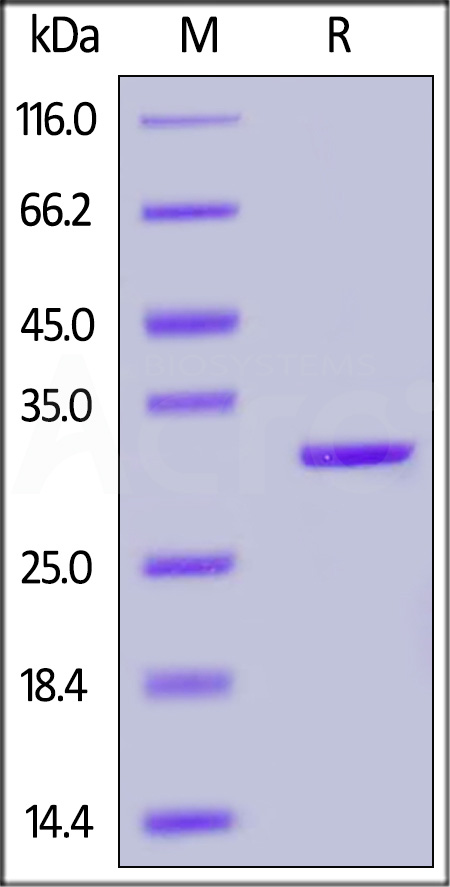
- 30.1 kDa
- Physical State:
- Powder
- Shipping Conditions:
- Ambient
- Storage Conditions:
- -20[o]C
- Supplier:
- ACRO Biosystems
- Type:
- Proteins, Peptides, Small Molecules & Other Biomolecules: Enzymes