A cutting-edge technology to enhance your detection!
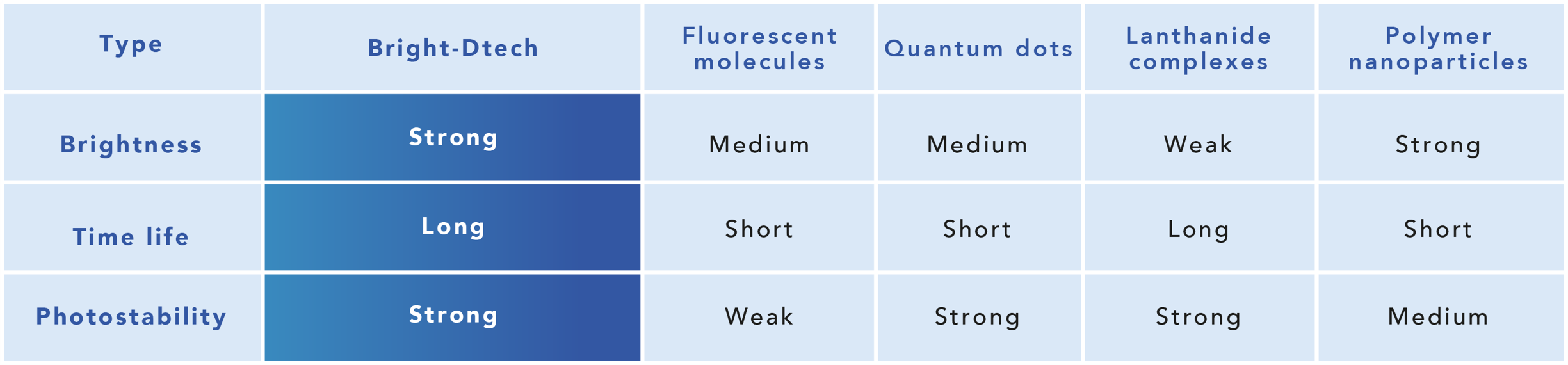
Poly-Dtech aims to overcome current technical limitations by designing and producing fluorescent nanomolecules to improve detection for scientific research and medical diagnostics. The Bright-Dtech™ technology is based on lanthanide nanoparticles, and their unique properties, including high brightness, make it possible to increase biomarker detection sensitivity. The high efficiency of the nanoparticles and their ease of use will enable them to replace current fluorescent molecules developed in the 2000s, which offer only moderate performance.
Wide range of applications:
- FastELISA
- TR-FLISA
- Lateral Flow
- Multiplexing
- Western Blot
- In vitro applications
- Immunofluorescent for microscopic analysis
- Quantitative PCR
Bright-Dtech™ for faster and more accurate immunoassays
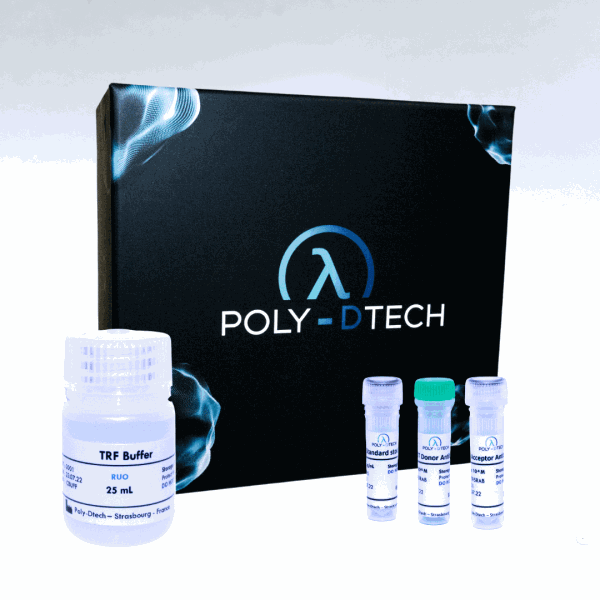
Based on Bright-Dtech™ technology, NoW-Dtech™ FastELISA Assay Kits represent an analytical method which can be used for the detection and quantification of specific target biomarkers or molecules in biological samples. It is a fast, low-interference and cost-effective method.
- Homogeneous (wash-free)
- Improved LOD
- Improved dynamic range
- Low sample and reagent consumption
.jpg?noresize&width=125&height=121&name=Bright-Dtech-545-Tb-(Green).jpg)
.png?noresize&width=125&height=125&name=Link-Dtech-545-%E2%80%93-Tb-(Green).png)
.jpg?noresize&width=130&height=125&name=Bright-Dtech-614-%E2%80%93-Eu-(Red).jpg)
.png?noresize&width=125&height=125&name=Link-Dtech-614-%E2%80%93-Eu-(Red).png)
FAQs
-
On what is the Bright-DtechTM technology based?
Bright-DtechTM is based on lanthanides nanoparticles.
Lanthanides are chemical elements with atomic numbers ranging from 57 to 71. In aqueous solvents, lanthanide ions typically exist in the +3 oxidation state (Ln3+), which is is the most stable in most cases. Each lanthanide element exhibits unique optical and magnetic properties. Today, lanthanides are primarily utilized as catalysts, magnets and are found in optical lasers, fibers and various electronics.
Nanoparticles are small objects measuring between 1 and 100nm and are used in various sectors such as healthcare, environmental preservation, and cosmetics among others. -
Why use Bright-DtechTM?
Based on lanthanides technology, Bright-DtechTM nanoparticles are 10-100x brighter than Quantum dots, which allow a more accurate detection and reduce detection limits.
The high efficiency of the nanoparticles and their ease of use will enable them to replace current fluorescent molecules developed in the 2000s, which offer only moderate performance.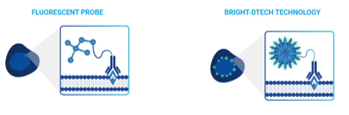
-
Why is Bright-DtechTM so bright?
With a large energy gap between the lowest excited state and the highest ground level, each lanthanide has a specific spectroscopic signature. The spectral range of lanthanides is large and they emit a strong luminescence:
- In the visible region Sm(3+), Eu(3+), Tb(3+), Dy(3+)
- In the near infrared region Nd(3+), Er(3+), Ho(3+), Tm(3+), Yb(3+)
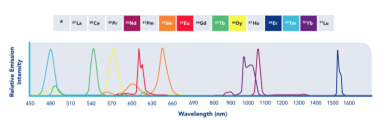
Bright-DtechTM's brightness is based on 3 factors:
- Molar absorption coefficient: Capacity of a molecule to absorb at a specific wavelength
- Quantum yield: Number of emitted photons per number of absorbed photons
- Brightness: With the luminescent quantum yield and the molar absorption coefficient, the brightness can be calculated by following equation:

-
What is fluorescence lifetime?
When a luminescent compound is excited, the excited state is populated and the return to ground state resuts in the emission of light. This de-excitation intensity decreases exponentially with time following the law below
Lifetime is the time a fluorophore stays in its excited state. Conventional fluorescent nanoparticles have very short luminescent lifetimes. Lanthanide nanoparticles have an exceptionally long lifetime, in the range of a millisecond. Long lifetime presents many advantages: low background noise, high intensity of emission, high sensitivity, accurate measurement.
-
Are there any relevant scientific publications?
- Ultra-bright lanthanide nanoparticles Terbium-doped LaF3 nanoparticles, surface functionalized by photon-harvesting antenna ligands. Surface capping with antenna
ligands leads to ultrabright nanoparticles, with the typical green luminescence signature
of Tb atoms and very long excited-state lifetimes Joan Goetz, Aline Nonat, Abdoulaye
Diallo, Mohamadou Sy, Ildan Sera, Alexandre Lecointre, Christophe Lefevre, Chi Fai
Chan, Ka-Leung Wong, Loïc J Charbonnière Chempluschem. 2016 Jun;81(6):497.
doi: 10.1002/cplu.201600117 - Ultrabright Terbium Nanoparticles for FastELISA Biosensing and In Situ Imaging of
Epidermal Growth Factor Receptors Design of a ligand that can be simultaneously
applied as an efficient light-harvesting antenna for Tb surface ions and a strong binder of
biomolecules to LnNPs surfaces. Cyrille Charpentier, Vjona Cifliku, Joan Goetz, Aline
Nonat, Clémence Cheignon, Marcelina Cardoso Dos Santos, Laura Francés-Soriano, Ka-
Leung Wong, Loïc J Charbonnière, Niko Hildebrandt Chemistry. 2020 Nov
17;26(64):14602-14611. doi: 10.1002/chem.202002007 - Live cell imaging without autofluorescence using terbium nanoparticles
Application of a new type of surface photosensitized terbium NPs (Tb-NPs) for
autofluorescence-free intracellular imaging in live HeLa cells. Combination of
exceptionally high brightness, high photostability, and long photoluminescence (PL)
lifetimes for highly efficient suppression of short-lived autofluorescence, enabling timed
PL imaging of intracellular vesicles over 72 h without toxicity and at extremely low
concentrations of Tb-NP for up to 12h. Joan Goetz, Marcelina Cardoso Dos Santos, Ka-
Leung Wong, Loïc J Charbonnière, Niko Hildebrandt, Hortense Bertenlian Bioconjugate
Chem. 2018, 29, 4, 1327–1334. doi: 10.1021/acs.bioconjchem.8b00069
- Ultra-bright lanthanide nanoparticles Terbium-doped LaF3 nanoparticles, surface functionalized by photon-harvesting antenna ligands. Surface capping with antenna
-
Which coupling can we choose with Bright-DtechTM?
Bright-DtechTM is available coupled to streptavidin, biotin, and IgG antibodies such as Anti-human IgG (H+L), Anti-Rabbit (H+L), Anti-Goat (H+L) and Anti-Mouse (H+L)
-
Can we use Bright-DtechTM in an already started FastELISA /TR-FLISA/Lateral Flow or multiplex test?
Yes, Bright-DtechTM can troubleshoot and even improve your detection issues encountered during protocol development.
-
Can we use Bright-DtechTM like a classical chromophore?
Sometimes, it depends on the application. Contact us to know how to use Bright-DtechTM for your application.
-
Can we use PBS with Bright-DtechTM?
It is strongly recommended not to use PBS Buffer with Bright-DtechTM
-
What are the best choices to detect small amount of antigen?
Bright-DtechTM 545-Tb (Green) and Bright-DtechTM 614-Eu (Red) are the optimal choices for detecting small amounts of antigens. The ultrafluorescence of these nanoparticles significantly enhances sensitivity.
-
What is included in the kit when choosing Bright-DtechTM?
Bright-DtechTM kits include the conjugated nanoparticles and the dilution buffer. We can include FastELISA buffer on demand.
-
What is the required materials to use Bright-DtechTM
To read Bright-DtechTM emissions, a TRF-compatible microplate reader is required. While Bright-DtechTM can be used without this TRF module, its performance significantly improves with it.
-
How many tests can we do with Bright-DtechTM?
Yes, Bright-DtechTM can troubleshoot and even improve your detection issues encountered during protocol development.

-
What are the TRF plate reader settings required?
These parameters depend on the measuring instrument and may vary. It's crucial to conduct experiments to determine the optimal combination. Feel free to reach out to us if you encounter any difficulties.

-
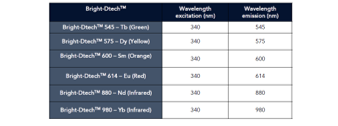
What are the excitation and emission wavelengths of Bright-DtechTM?
-
How is Bright-DtechTM stored?
Bright-DtechTM and all the components must be stored at 4 degrees celsius.
-
What is the shelf life of Bright-DtechTM?
The shelf life of conjugated nanoparticles is around 6-12 months.