VectaPlex™ Antibody Removal Kit
The newest, cutting-edge and world leading product from Vector Laboratories!
Meet VectaPlex™, the newest addition to the Vector Laboratories range!
This ready-to-use kit is designed to remove antibodies and other non-covalently bound detection reagents from formalin-fixed paraffin-embedded (FFPE) tissue sections, without using damaging heating steps. The technology can be used to enable multiple labelling with either fluorescent secondaries, and can be used in tyramide based multiple labelling protocols.
Samples after 3 Rounds of VectaPlex™
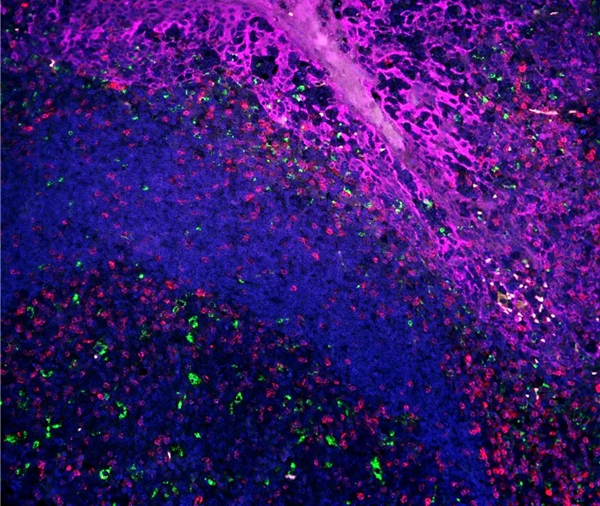
Image captured after completion of 3 rounds of Tyramide staining. VectaPlexTM was used after each round. FFPE tonsil; 3 mouse primary antibodies (CD3 (red), CD68 (Green), AE1/AE3 (Purple)); dtected using Opal 3-Plex TSA Kit.
Samples after 6 Rounds of VectaPlex™
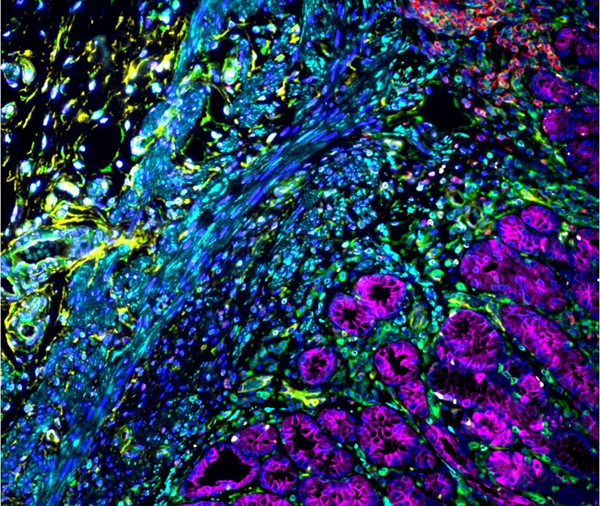
Composite image generated from individual images taken during 6 rounds of IF staining VectaPlexTM. FFPE stomach; 6 mouse primaries (CD20 (Red), CD34 (Yellow), DES (Cyan, AE1/AE3 (Magenta), CD3 (Grey), VIM (Green)); DyLight 488 horse anti-mouse IgG.
See below for the complete VectaPlex™ User Guide, as well as some FAQs.
Frequently asked questions
-
Can other substrates be used with VectaPlex?
Perhaps. We have not tested substrates from other vendors but they may be compatible. To test this, simply stain two sections with the substrate in question and treat one of them with VectaPlex. If the staining intensity is unchanged, the substrate should be compatible with VectaPlex.
-
Can I use VectaPlex on frozen sections?
No. During development, VectaPlex was optimized for FFPE tissues, where the power to remove antibodies at room temperature was balanced with the need to preserve tissue morphology. On frozen tissues, VectaPlex treatment can lead to tissue damage and loss.
-
I am using TrueView to quench autofluorescence; will TrueVIEW be stripped by VectaPlex reagents?
We used TrueView in our VectaPlex IF workflow to suppress autofluorescence. Application of VectaPlex removes some, but not all, of the TrueView reagent. Since some TrueView remained after VectaPlex application, we did not add TrueView in every cycle, but only as needed to suppress autofluorescence.
-
I accidentally put my VectaPlex™ kit in the freezer. Can I still use it?
Yes. VectaPlex™can withstand a freeze-thaw cycle and still perform as expected, but the recommended storage is at ambient temperature (15-25 °C). Additionally, the kit will still perform properly if placed at 4 °C.
-
Is there a maximum number of times you can use VectaPlex™ on one section?
VectaPlex™ has been tested for up to 6 cycles with no ill effects. We don’t expect there to be issues with increasing the number of cycles, but we suggest testing with controls for adequate comparisons. We recommend running experiments to confirm that the use of more cycles does not impact the antigenicity or tissue morphology.
-
Can VectaPlex™ be used on an autostainer?
We have not tested this product on automated systems and cannot guarantee instrument compatibility at this time.
-
Does VectaPlex™ work for all species of antibodies?
VectaPlex™ has been tested with mouse and rabbit primaries, and with horse and goat secondaries. We expect it to work well with other species of antibodies as well.
-
Does VectaPlex™ work on different tissue types?
VectaPlex™ has been tested on and works well with various FFPE tissues, including FFPE breast and lung tissue which are very fragile.
-
Is VectaPlex™ compatible with all antibodies?
VectaPlex™ has been tested on more than 30 common antibodies and has worked on them without issue.
-
In an IF protocol, will the VectaPlex™ Antibody Removal Kit also strip the autofluorescence from the tissue?
VectaPlex™ does not appear to reduce autofluorescence background.
-
Is there a protocol for removal of coverslips between VectaPlex™ cycles?
We recommend using VectaShield® Plus Antifade Mounting Media with DAPI (H-2000), which is an aqueous non-hardening mounting medium. After each imaging cycle, the coverslip can be easily removed by incubating in PBS and the residual VectaShield® removed with a PBS wash.