
Skip to content

CellFree Sciences

"It is our goal to make proteins work!" CellFree Sciences is using its own wheat germ cell-free protein expression system to serve protein needs in life sciences and for industrial use. Performing protein synthesis outside of the cell in an in vitro system allows us to separate protein production from other processes required to maintain a cell. Thus, working cell-free opens new opportunities to better adopt protein synthesis to protein needs offering dedicated reagents to make for example membrane proteins in a lipid environment, labeled proteins for use in MS or NMR, or well-folded antigens for antibody production. Our scalable and flexible expression system can serve protein needs from the small amounts used for production of our protein bead arrays presenting up to 23,000 human full-length proteins to individual proteins made on large-scale for use in structural biology, medical research, on-demand product production, and diagnostic tests. Our eukaryotic expression system has a strong record on supporting a wide range of projects working on all kinds of proteins from the kingdoms of life.

Why Choose CFS over other protein expression options?

Carrying out protein expression without needing a living host cell creates many advantages, which have been listed below.

Protein expression rates/Solubility

The CellFree system has higher expression rates and solubility than other protein expression systems. Using CellFree Sciences products and services may resolve issues with proteins that could not be expressed using other expression systems, or became insoluble after expression.

In most cases, the highest yields can be obtained through the wheat germ cell free expression system.

Reproducibility/Scalability

The amounts of protein expressed are more or less constant no matter how many times the expression is carried out, as the system has a high reproducibility.

Additional syntheses and cost calculations can be done easily once the target protein yield is confirmed, which helps to efficiently plan ahead.

Ease of Operations

Proteins can be obtained using only a pipette to adjust the reagents, and an incubator to control temperature.

No Codon Optimisation Necessary

A wheat germ cell-free protein expression system is less sensitive to codon bias , so there is no need for codon optimization (no preferred codon changes are needed for the host), and the genes from the original species can be used as is.

The is no decrease in the amounts expressed, even for mRNA with a unique sequence.

Selectivity of synthesis conditions

The conditions needed for protein expression are flexible, as the RNase activity for the wheat germ extract is extremely low and the reaction conditions for the translation stage can be changed freely depending on the purpose.

Variables such as temperature, time and reactivities can all be changed depending on what is desired.

Can be used internationally

There are no limitations to obtaining proteins from these systems internationally, as they do not fall under the Act on the Conservation and Sustainable Use of Biological Diversity through Regulations on the Use of Living Modified Organisms.

This allows for international group projects to use the CellFree system without the hassle of export restrictions.

Wheat Germ Cell-Free Protein Expression System

The Power of Wheat Driving Science

CellFree Sciences is using its own wheat germ cell-free protein expression system to serve protein needs in life sciences and for industrial use. Performing protein synthesis outside of the cell in an in vitro system allows us to separate protein production from other processes required to maintain a cell.
Wheat-gem-extract

Features

  • High-performance wheat germ extracts developed at CFS for superior protein yields

  • Dedicated extracts for expression of GST-tagged and His-tagged proteins (G and H versions)

  • Dedicated amino acid-free reagents for protein labelling (WEPRO®8240 Series)

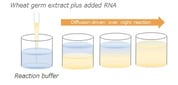
  • Examples show the expression of DHFR using 6 ml bilayer reactions on CFS’ fully automated Protemist DTII protein synthesizer.

  • Precleared wheat germ extracts of the G or H versions allow for higher protein purity after one-step protein purification.

Supported Reaction Formats

  • ONE Kit: Coupled transcription-translation system for quick protein expression experiments

  • Protein Research Kits: Premixed transcription and translation reagents to perform bilayer reactions

  • Core Kits: Individual reagents to perform bilayer reactions on different scales

  • Dialysis Kits: Individual reagents to perform dialysis-driven expression reactions

tube

Special Applications

  • FLEXIQuant standards: Modified reaction conditions allow for up to 99% labelling efficiency for incorporating [13C, 15N]-L-Lys and [13C, 15N]-L-Arg from Cambridge Isotope Laboratories to prepare standards for quantitative protein MS, studies on PTMs, and proteomics
  • NMR samples: Expression kits with isotope-labelled amino acids from Cambridge Isotope Laboratories
  • ProteoLiposome BD Kit: Expression of membrane proteins in the presence of added liposomes

Recent Citations and Publications

Here to help you

At 2BScientific, we follow the motto “No-one does more for the customer” and we look forward to proving that to our valued customers!