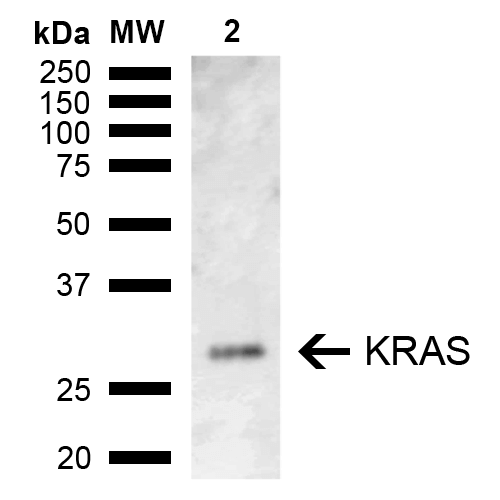
SPC-777
KRAS Antibody

Cannot supply to this region.
- SKU:
- SPC-777
- Additional Names:
- KRAS, KRAS1, KRAS2, K-Ras 2, K RAS2A, K RAS2B, K RAS4A, K RAS4B, Ki-Ras, c-Ki-ras, c-K-ras, cK Ras, cK-ras, RASK2, RASK_HUMAN, NS3, NS, p21ras, K RAS p21 protein, GTPase KRas, Transforming protein p21, Oncogene KRAS2, Kirsten rat sarcoma 2 viral (v Ki ras2) oncogene homolog, v Ki ras2 Kirsten rat sarcoma viral oncogene homolog, Cellular c Ki ras2 proto oncogene, PR310 cK ras oncogene, KIRSTEN MURINE SARCOMA VIRUS 2
- Application:
- WB
- Concentration:
- 1 mg/ml
- Species Reactivity:
- Human
- Purification:
- Affinity Purified
- Storage Conditions:
- -20[o]C
- Supplier:
- StressMarq Biosciences
- Host:
- Rabbit
- Reactivities:
- Rat
- ABP:
- IMP-GEN-2015-06 < 10% Serum <100ml
- Buffer:
- PBS pH 7.4, 50% glycerol, 0.09% sodium azide
- Immunogen:
- Synthetic peptide from the C-terminal of Human KRAS (aa. 100-189)
- Uniprot:
- P01116
- Synonyms:
- 'C-K-RAS;C-K-RAS;c-Ki-ras;c-Ki-ras2;c-Kirsten-ras protein;cellular c-Ki-ras2 proto-oncogene;cellular transforming proto-oncogene;CFC2;GTPase KRas;K-Ras;K-Ras 2;K-ras p21 protein;K-RAS2A;K-RAS2B;K-RAS4A;K-RAS4B;KI-RAS;Kirsten rat sarcoma viral oncogene homolog;Kirsten rat sarcoma viral proto-oncogene;KRAS1;KRAS2;NS;NS3;OES;oncogene KRAS2;PR310 c-K-ras oncogene;RALD;RASK2;transforming protein p21;v-Ki-ras2 Kirsten rat sarcoma 2 viral oncogene homolog
- Extra Details:
- KRAS, a well-characterized oncogene encoding a small GTPase, is emerging as a critical player in neurodegenerative disease research. Traditionally studied in cancer biology, KRAS regulates key cellular processes such as proliferation, differentiation, and survival through the MAPK/ERK and PI3K/AKT pathways. Recent studies suggest that dysregulation of KRAS signaling may contribute to neuronal vulnerability, synaptic dysfunction, and neuroinflammation-hallmarks of disorders like Alzheimer's disease, Parkinson's disease, and amyotrophic lateral sclerosis (ALS). In the central nervous system, KRAS is expressed in neurons and glial cells, where it modulates neurodevelopmental signaling and cellular stress responses. Aberrant KRAS activity has been linked to impaired autophagy, mitochondrial dysfunction, and altered neurotrophic signaling, all of which are implicated in progressive neurodegeneration. Moreover, KRAS-mediated pathways intersect with tau phosphorylation and amyloid precursor protein processing, positioning KRAS as a potential upstream regulator of pathogenic cascades. Understanding KRAS function in neural contexts opens new avenues for therapeutic intervention. Targeting KRAS or its downstream effectors may offer neuroprotective strategies, particularly in early-stage disease. As neuroscience increasingly intersects with molecular oncology, KRAS represents a promising biomarker and mechanistic bridge between cancer biology and neurodegeneration.
- Shipping Conditions:
- Blue Ice