
SMC-621
Alpha Synuclein N-terminal Antibody, Clone 11D4

Cannot supply to this region.
- SKU:
- SMC-621
- Additional Names:
- Alpha Synuclein, A Alpha-Synuclein, SNCA, alphaSYN, NACP, Non-A beta component of AD amyloid, Non-A4 component of amyloid precursor, Synuclein alpha, Synuclein alpha 140, Synuclein, alpha (non A4 component of amyloid precursor), isoform NACP140, PARK1, PARK 1, PARK4, PARK 4, Parkinson disease familial 1, Parkinson disease (autosomal dominant, Lewy body) 4, SYN, SYUA_HUMAN
- Application:
- IHC, WB
- Concentration:
- 1 mg/ml
- Species Reactivity:
- Human
- Purification:
- Protein G Purified
- Storage Conditions:
- -20[o]C
- Supplier:
- StressMarq Biosciences
- Host:
- Mouse
- Reactivities:
- Human, Mouse, Rat
- Buffer:
- PBS pH7.4, 50% glycerol, 0.09% sodium azide
- Immunogen:
- Alpha synuclein aa 1-20
- Clone:
- 11D4
- Uniprot:
- P37840
- Synonyms:
- alpha-synuclein;I+/--synuclein;NACP;non A-beta component of AD amyloid;Non-A beta component of AD amyloid;Non-A4 component of amyloid precursor;PARK1;PARK4;PD1;synuclein alpha-140;synuclein, alpha (non A4 component of amyloid precursor);truncated alpha synuclein
- Extra Details:
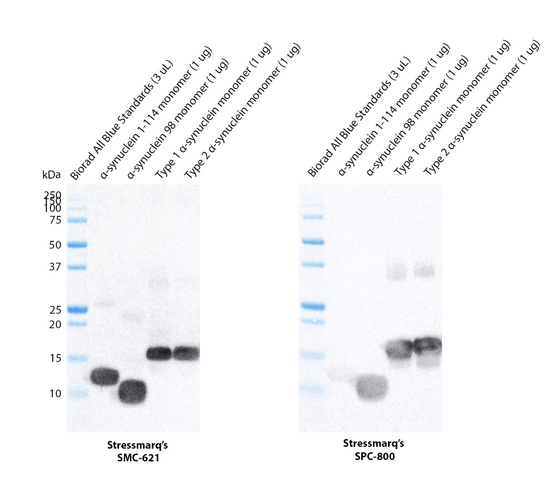
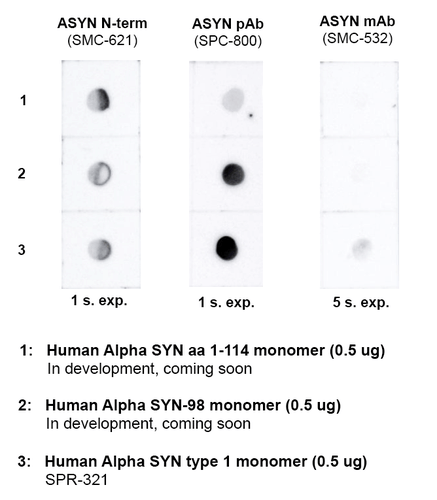
- Alpha-synuclein is a presynaptic neuronal protein implicated in the pathogenesis of several neurodegenerative diseases, including Parkinson's disease and dementia with Lewy bodies. Among its structural domains, the N-terminal region plays a pivotal role in membrane binding, conformational dynamics, and aggregation behavior. Post-translational modifications, particularly C-terminal truncations, significantly influence alpha-synuclein's aggregation propensity and neurotoxicity (1). C-terminally truncated alpha-synuclein species are highly enriched in pathological inclusions such as Lewy bodies and Lewy neurites. These truncated forms exhibit accelerated fibrillization and enhanced prion-like propagation in cellular and animal models of Parkinson's disease, underscoring their pathogenic relevance (1). Importantly, such truncations can alter the structural conformation of alpha-synuclein, masking epitopes commonly targeted by antibodies, including those recognizing phosphorylated serine 129 (pSer129) . This epitope masking has critical implications for research and diagnostics. Antibodies specific to pSer129 may fail to detect C-terminally truncated alpha-synuclein, potentially underestimating the burden of pathogenic species in tissue samples. Therefore, careful selection of antibodies that target the N-terminal region is essential for accurate detection and quantification of disease-relevant alpha-synuclein conformers (3). Understanding the structural and functional roles of the alpha-synuclein N-terminus is vital for elucidating disease mechanisms and developing targeted therapeutic strategies in synucleinopathies.
- Shipping Conditions:
- Blue Ice