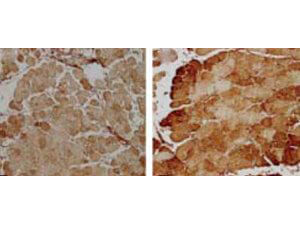
600-401-G14
SOD2 Antibody

Cannot supply to this region.
- SKU:
- 600-401-G14
- Additional Names:
- Manganese SOD, IPO B, Mn SOD, SOD2, Superoxide dismutase [Mn], mitochondrial|SOD2
- Application:
- ELISA, IHC, WB, IP
- Concentration:
- 1 mg/ml
- Physical State:
- Liquid
- Species Reactivity:
- Human
- Storage Conditions:
- -20[o]C aliquoted. Aliquot. Avoid freeze/thaw cycles., 2-8[o]C diluted. Aliquot. Avoid freeze/thaw cycles.
- Supplier:
- Rockland Inc
- Host:
- Rabbit
- Reactivities:
- Bovine, Canine, Hamster, Human, Mouse, Porcine, Rabbit, Rat, Guinea Pig, Ovine
- Buffer:
- 0.02 M Potassium Phosphate, 0.15 M Sodium Chloride
- Immunogen:
- SOD2 Antibody was produced from whole rabbit serum prepared by repeated immunizations raised against human SOD2.
- Formulation:
- 0.02 M Potassium Phosphate, 0.15 M Sodium Chloride, pH 7.2
- Uniprot:
- P04179
- Synonyms:
- epididymis secretory sperm binding protein;gastric cancer-associated lncRNA 1;GClnc1;indophenoloxidase B;IPO-B;IPOB;manganese-containing superoxide dismutase;mangano-superoxide dismutase;Mn superoxide dismutase;Mn-SOD;MNSOD;MVCD6;superoxide dismutase [Mn], mitochondrial;superoxide dismutase 2, mitochondrial
- Extra Details:
- Superoxide dismutase (SOD) is an endogenously produced intracellular enzyme present in almost every cell in the body. It works by catalyzing the dismutation of the superoxide radical O2 to O2 and H2O2, which are then metabolized to H2O and O2 by catalase and glutathione peroxidase. In general, SODs play a major role in antioxidant defense mechanisms. There are two main types of SOD in mammalian cells. One form (SOD1) contains Cu and Zn ions as a homodimer and exists in the cytoplasm. The two subunits of 16 kDa each are linked by two cysteines forming an intra-subunit disulphide bridge (3). The second form (SOD2) is a manganese containing enzyme and resides in the mitochondrial matrix. It is a homotetramer of 80 kDa. The third form (SOD3 or EC-SOD) is like SOD1 in that it contains Cu and Zn ions, however it is distinct in that it is a homotetramer, with a mass of 30 kDA and it exists only in the extra-cellular space. SOD3 can also be distinguished by its heparin-binding capacity.
- Shipping Conditions:
- Dry Ice