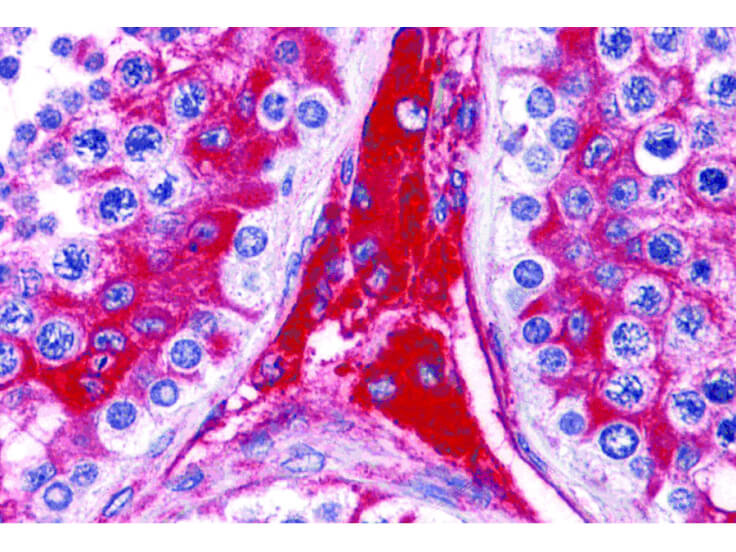
600-401-FX9
WDR35 Antibody

Cannot supply to this region.
- SKU:
- 600-401-FX9
- Additional Names:
- WDR35|WDR35 Antibody, CED2, IFTA1, SRTD7, IFT121, KIAA1336, WD repeat-containing protein 35, Intraflagellar transport protein 121 homolog
- Application:
- ELISA, IHC
- Concentration:
- 1 mg/ml
- Physical State:
- Liquid
- Species Reactivity:
- Human
- Storage Conditions:
- -20[o]C aliquoted. Aliquot. Avoid freeze/thaw cycles., 2-8[o]C diluted. Aliquot. Avoid freeze/thaw cycles.
- Supplier:
- Rockland Inc
- Host:
- Rabbit
- Reactivities:
- Human
- Buffer:
- 0.01 M Sodium Phosphate, 0.25 M Sodium Chloride
- Immunogen:
- Anti-WDR35 antibody was prepared from whole rabbit serum produced by repeated immunizations with a 16 amino acid synthetic peptide near the N-terminus of human WDR35.
- Formulation:
- 0.01 M Sodium Phosphate, 0.25 M Sodium Chloride, pH 7.2
- Uniprot:
- Q9P2L0
- Synonyms:
- CED2;FAP118;IFT121;IFTA1;intraflagellar transport protein 121 homolog;naofen;SRTD7;WD repeat-containing protein 35
- Extra Details:
- WD40 repeats are a common structural module in eukaryotic proteins, and proteins containing WD40 domains have a wide range of functions, including signal transduction, cell cycle regulation, RNA splicing, and transcription. One such protein, WDR35, also known as CED2, has been shown to be mutated in patients with Sensenbrenner syndrome/cranioectodermal dysplasia (CED), an autosomal-recessive disease that is characterized by craniosynstosis and ectodermal and skeletal abnormalities. WDR35 localizes to cilia and dentrosomes during embryogenesis and human and mouse fibroblasts that lack this gene fail to produce cilia. Mutations in this gene can also cause short-rib polydactyly syndromes due to abnormal ciliogenesis.
- Shipping Conditions:
- Dry Ice