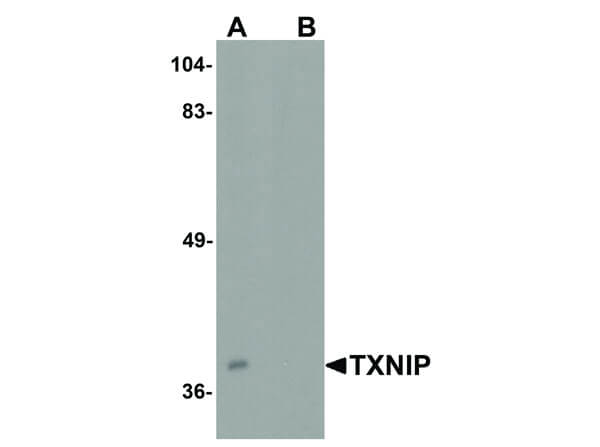
600-401-FT0
TXNIP Antibody

Cannot supply to this region.
- SKU:
- 600-401-FT0
- Additional Names:
- Thioredoxin-interacting protein, BMP and activin membrane-bound inhibitor homolog, non-metastatic gene A protein, NMA|TXNIP
- Application:
- ELISA, IHC, WB, IF
- Concentration:
- 1 mg/ml
- Physical State:
- Liquid
- Species Reactivity:
- Human
- Storage Conditions:
- -20[o]C aliquoted. Aliquot. Avoid freeze/thaw cycles., 2-8[o]C diluted. Aliquot. Avoid freeze/thaw cycles.
- Supplier:
- Rockland Inc
- Host:
- Rabbit
- Reactivities:
- Human, Mouse, Rat
- Buffer:
- 0.01 M Sodium Phosphate, 0.25 M Sodium Chloride
- Immunogen:
- Anti-TXNIP antibody was prepared from whole rabbit serum produced by repeated immunizations with a 16 amino acid peptide near the internal region of human TXNIP
- Formulation:
- 0.01 M Sodium Phosphate, 0.25 M Sodium Chloride, pH 7.2
- Uniprot:
- Q9H3M7
- Synonyms:
- ARRDC6;EST01027;HHCPA78;THIF;thioredoxin binding protein 2;Thioredoxin-binding protein 2;thioredoxin-interacting protein;upregulated by 1,25-dihydroxyvitamin D-3;VDUP1;vitamin D3 up-regulated protein 1
- Extra Details:
- Thioredoxin-interacting protein (TXNIP) belongs to the arrestin family and plays a critical role in the antioxidant defense mechanisms of hematopoietic cells by activating the p53 pathway during oxidative stress (1,2). It functions as a transcriptional repressor and acts as an oxidative stress mediator by inhibiting thioredoxin activity (2). TXNIP expression is reduced in many types of tumors, and TXNIP overexpression inhibits tumor growth by blocking cell-cycle progression (3). It has recently reported that TXNIP deficiency correlates with a high incidence of hepatocellular carcinoma (HCC) (4). TXNIP and p53 interactions could potentially be a therapeutic target for oxidative stress-related diseases such as hematopoietic malignancies and metabolic diseases (5).
- Shipping Conditions:
- Dry Ice