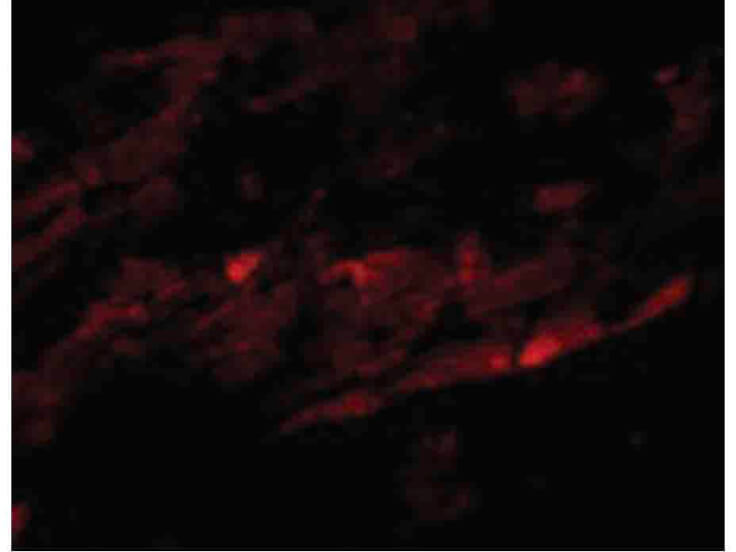
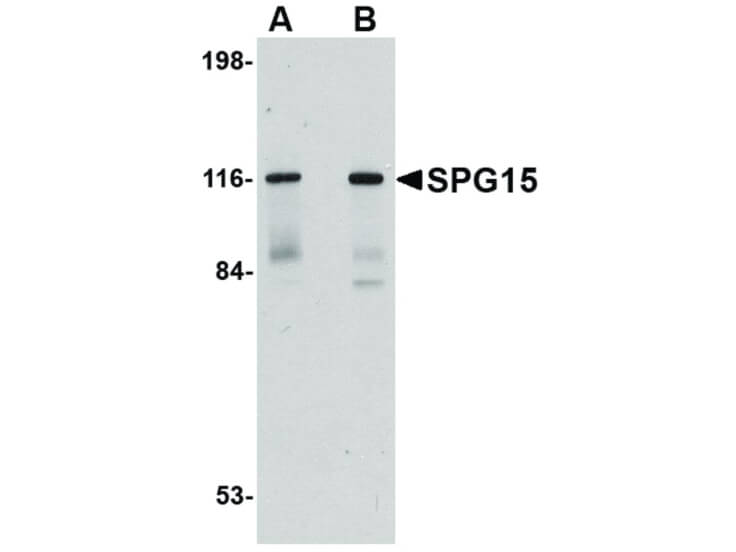
600-401-ET3
SPG15 Antibody

Cannot supply to this region.
- SKU:
- 600-401-ET3
- Additional Names:
- SPG15 Antibody, SPG15, FYVE-CENT, KIAA0321, Zinc finger FYVE domain-containing protein 26, FYVE domain-containing centrosomal protein|ZFYVE26
- Application:
- ELISA, WB, IF
- Concentration:
- 1 mg/ml
- Physical State:
- Liquid
- Species Reactivity:
- Human
- Storage Conditions:
- -20[o]C aliquoted. Aliquot. Avoid freeze/thaw cycles., 2-8[o]C diluted. Aliquot. Avoid freeze/thaw cycles.
- Supplier:
- Rockland Inc
- Host:
- Rabbit
- Reactivities:
- Human, Mouse, Rat
- Buffer:
- 0.01 M Sodium Phosphate, 0.25 M Sodium Chloride
- Immunogen:
- Anti-SPG15 antibody was prepared from whole rabbit serum produced by repeated immunizations with a 16 amino acid synthetic peptide near the C-terminus of human SPG15.
- Formulation:
- 0.01 M Sodium Phosphate, 0.25 M Sodium Chloride, pH 7.2
- Uniprot:
- Q68DK2
- Synonyms:
- FYVE domain-containing centrosomal protein;FYVE-CENT;spastizin;SPG15;zinc finger FYVE domain-containing protein 26;zinc finger, FYVE domain containing 26
- Extra Details:
- Hereditary spastic paraplegias (HSPs) are genetically and phenotypically heterogeneous disorders. Spastic paraplegia with thinning of the corpus callosum (ARHSP-TCC) is a relatively frequent form of complicated hereditary spastic paraplegia in which mental retardation and muscle stiffness at onset are followed by slowly progressive paraparesis and cognitive deterioration. SPG15 is the second gene known to be responsible for ARHSP-TCC in the Italian population. Mutations in this gene are associated with autosomal recessive spastic paraplegia-15. SPG15 encodes a protein containing a FYVE zinc finger binding domain which is thought to target these proteins to membrane lipids through interaction with phospholipids in the membrane. SPG15 mRNA is widely distributed in human tissues, as well as in rat embryos, suggesting a possible role for this protein during embryonic development. SPG15 co-localizes partially with endoplasmic reticulum and endosome markers, suggesting a role in intracellular trafficking. Multiple isoforms of SPG15 are known to exist.
- Shipping Conditions:
- Dry Ice