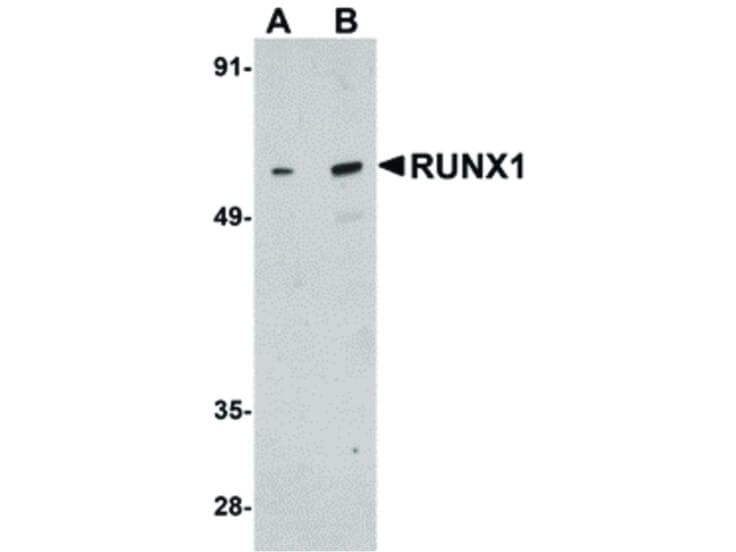
600-401-EC9
RUNX1 Antibody

Cannot supply to this region.
- SKU:
- 600-401-EC9
- Additional Names:
- RUNX1|RUNX1 Antibody, AML1, CBFA2, EVI-1, AMLCR1, PEBP2aB, AML1-EVI-1, AML1, Runt-related transcription factor 1, Acute myeloid leukemia 1 protein, CBF-alpha-2
- Application:
- ELISA, WB
- Concentration:
- 1 mg/ml
- Physical State:
- Liquid
- Species Reactivity:
- Human
- Storage Conditions:
- -20[o]C aliquoted. Aliquot. Avoid freeze/thaw cycles., 2-8[o]C diluted. Aliquot. Avoid freeze/thaw cycles.
- Supplier:
- Rockland Inc
- Host:
- Rabbit
- Reactivities:
- Human, Mouse, Rat
- Buffer:
- 0.01 M Sodium Phosphate, 0.25 M Sodium Chloride
- Immunogen:
- Anti-RUNX1 antibody was prepared from whole rabbit serum produced by repeated immunizations with a 16 amino acid synthetic peptide from near the internal region of human RUNX1.
- Formulation:
- 0.01 M Sodium Phosphate, 0.25 M Sodium Chloride, pH 7.2
- Uniprot:
- Q01196
- Synonyms:
- acute myeloid leukemia 1 protein;AML1;AML1-ETO fusion;AML1-ETO fusion protein;AML1-EVI-1;AML1-EVI-1 fusion protein;AMLCR1;CBF2alpha;CBFA2;Core-binding factor subunit alpha-2;core-binding factor, runt domain, alpha subunit 2;EVI-1;mutant RUNX1;oncogene AML-1;PEA2-alpha B;PEBP2-alpha B;PEBP2aB;PEBP2alpha;polyomavirus enhancer-binding protein 2 alpha B subunit;runt related transcription factor 1;runt-related transcription factor 1;SL3-3 enhancer factor 1 alpha B subunit;SL3/AKV core-binding factor alpha B subunit
- Extra Details:
- RUNX1 is one of three mammalian RUNX genes that control multiple aspects of embryonic development and are responsible for the pathogenesis of many human diseases. RUNX1 plays major roles in the development of nociceptive sensory neurons in addition to hematopoietic stem cells (HSC) with the exception of the erythroid lineage. During development, Notch signals mediate RUNX1 induction with SCL/GATA/Ets factors, and Wnt signals potentially cooperate with RUNX1 to facilitate adult HSC expansion via cooperative induction of cyclin D, cdk4, and other cell cycle regulators. In turn, RUNX1 regulates cell cycle transitions dependent on functional/physical interactions with other proteins such as HDAC1 and -3, mSin3A, p300, SMAD proteins, and LEF/TCF.
- Shipping Conditions:
- Dry Ice