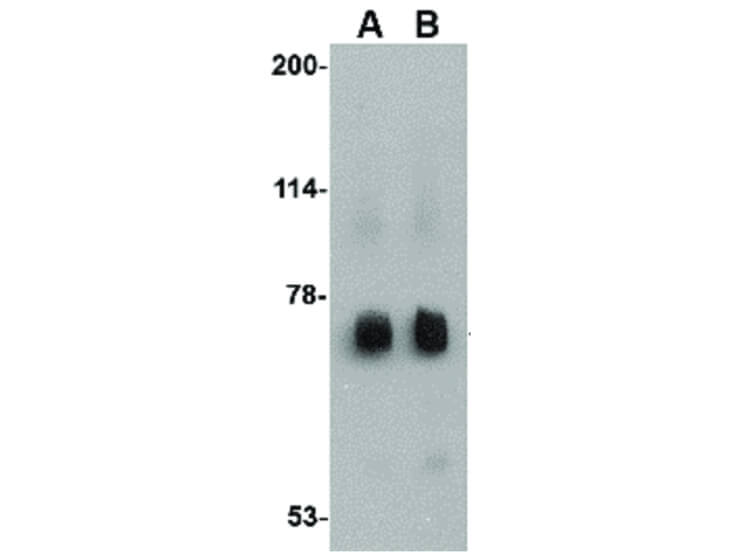
600-401-EA5
RKHD2 Antibody

Cannot supply to this region.
- SKU:
- 600-401-EA5
- Additional Names:
- MEX3C|Rkhd2 Antibody, RKHD2, BM-013, MEX-3C, RNF194, RKHD2, RNA-binding E3 ubiquitin-protein ligase MEX3C, RING finger and KH domain-containing protein 2
- Application:
- ELISA, WB
- Concentration:
- 1 mg/ml
- Physical State:
- Liquid
- Species Reactivity:
- Human
- Storage Conditions:
- -20[o]C aliquoted. Aliquot. Avoid freeze/thaw cycles., 2-8[o]C diluted. Aliquot. Avoid freeze/thaw cycles.
- Supplier:
- Rockland Inc
- Host:
- Rabbit
- Reactivities:
- Human, Mouse, Rat
- Buffer:
- 0.01 M Sodium Phosphate, 0.25 M Sodium Chloride
- Immunogen:
- Anti-Rkhd2 antibody was prepared from whole rabbit serum produced by repeated immunizations with a 15 amino acid synthetic peptide from near the C-terminus of human RKHD2.
- Formulation:
- 0.01 M Sodium Phosphate, 0.25 M Sodium Chloride, pH 7.2
- Uniprot:
- Q5U5Q3
- Synonyms:
- BM-013;MEX-3C;MEX3C variant 1;MEX3C variant 2;ring finger and KH domain containing 2;RING finger and KH domain-containing protein 2;RING finger protein 194;RING-type E3 ubiquitin transferase MEX3C;RKHD2;RNA-binding E3 ubiquitin-protein ligase MEX3C;RNA-binding protein MEX3C;RNF194
- Extra Details:
- Rkhd2, also known as MEX3C is a member of a novel family of four homologous human MEX3 proteins each containing two heterogeneous nuclear ribonucleoprotein K homology (KH) domains and one carboxy-terminal RING finger module. MEX3 proteins, including Rkhd2, are phosphoproteins that bind RNA through their KH domains and shuttle between the nucleus and the cytoplasm via the CRM1 export pathway. These proteins are a novel family of evolutionarily conserved RNA-binding proteins, differentially recruited to P bodies and potentially involved in post-transcriptional regulatory mechanisms. It has been suggested that genetic variations in Rkhd2 may be associated with susceptibility to essential hypertension type 8. Rkhd3 and Rkhd4, but not Rkhd2, co-localize with both the hDcp1a decapping factor and Argonaute (Ago) proteins in processing bodies (P bodies), recently characterized as centers of mRNA turnover.
- Shipping Conditions:
- Dry Ice