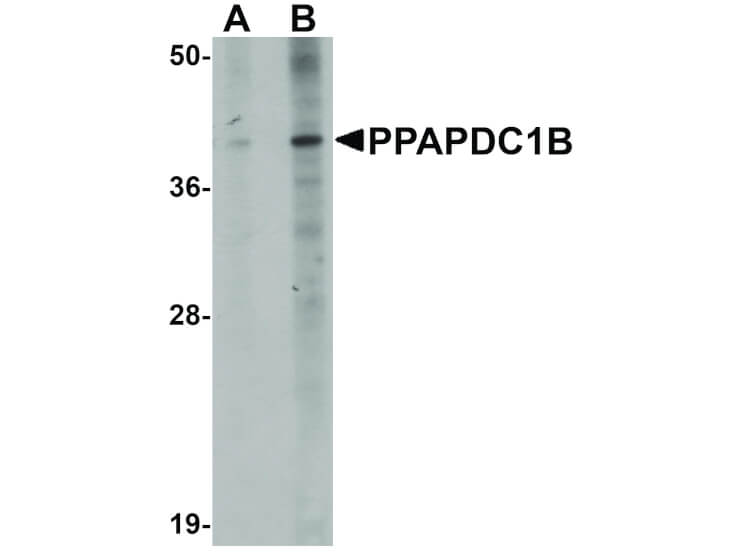
600-401-DR7
PPAPDC1B Antibody

Cannot supply to this region.
- SKU:
- 600-401-DR7
- Additional Names:
- PLPP5|PPAPDC1B Antibody, DPPL1, HTPAP, DPPL1, Phosphatidate phosphatase PPAPDC1B, Phosphatidic acid phosphatase type 2 domain-containing protein 1B
- Application:
- ELISA, WB
- Concentration:
- 1 mg/ml
- Physical State:
- Liquid
- Species Reactivity:
- Human
- Storage Conditions:
- -20[o]C aliquoted. Aliquot. Avoid freeze/thaw cycles., 2-8[o]C diluted. Aliquot. Avoid freeze/thaw cycles.
- Supplier:
- Rockland Inc
- Host:
- Rabbit
- Reactivities:
- Human, Mouse
- Buffer:
- 0.01 M Sodium Phosphate, 0.25 M Sodium Chloride
- Immunogen:
- Anti-PPAPDC1B antibody was prepared from whole rabbit serum produced by repeated immunizations with a 14 amino acid synthetic peptide near the N-terminus of human PPAPDC1B.
- Formulation:
- 0.01 M Sodium Phosphate, 0.25 M Sodium Chloride, pH 7.2
- Uniprot:
- Q8NEB5
- Synonyms:
- diacylglycerol pyrophosphate like 1;diacylglycerol pyrophosphate phosphatase-like 1;DPPL1;HTPAP;phosphatidate phosphatase PPAPDC1B;phosphatidic acid phosphatase type 2 domain containing 1B;phosphatidic acid phosphatase type 2 domain-containing protein 1B;phospholipid phosphatase 5;PPAPDC1B;testicular secretory protein Li 38
- Extra Details:
- Phosphatidate phosphatase (PAP) plays important role in lipid-signaling metabolism in eukaryotic cells. Two distinct types of PAP (PAP1 and PAP2) activity have been distinguished by their subcellular localization and differential sensitivity to N-ethylmaleimide (NEM) and Mg2+. A yeast diacylglycerol pyrophosphate (DGPP) phosphatase (DPP1) and mammalian DGPP phosphatase (PAP2) have been identified as Mg2+-independent and NEM-insensitive membrane-associated. PPAPDC1A (also known as DPPL2) and PPAPDC1B (DPPL1) form a novel type of Mg2+-independent and NEM-sensitive mammalian phosphatidate phosphatase showing broad substrate specificity. Knockdown experiments indicated that this protein is involved with multiple cell signaling pathways, including the JAK-Stat3, MAP kinase, and PKC pathways. PPAPDC1B may also potentiate the estrogen receptor pathway by down-regulating DUSP22.
- Shipping Conditions:
- Dry Ice