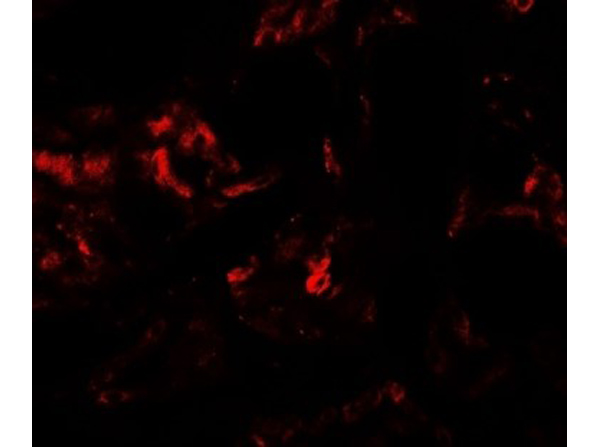
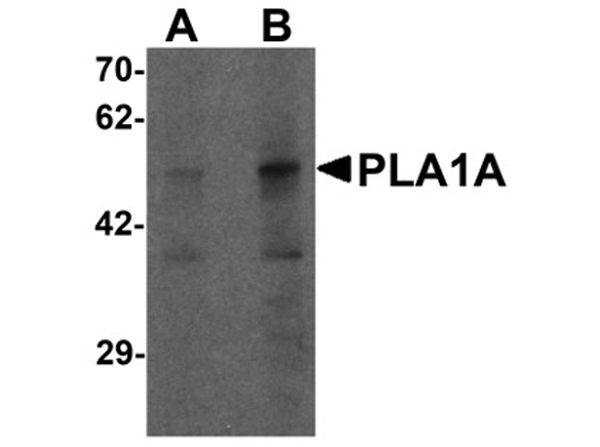
600-401-DP9
PLA1A Antibody

Cannot supply to this region.
- SKU:
- 600-401-DP9
- Additional Names:
- PLA1A|PLA1A Antibody, PSPLA1, PS-PLA1, NMD, PSPLA1, Phospholipase A1 member A, Phosphatidylserine-specific phospholipase A1
- Application:
- ELISA, WB, IF
- Concentration:
- 1 mg/ml
- Physical State:
- Liquid
- Species Reactivity:
- Human
- Storage Conditions:
- -20[o]C aliquoted. Aliquot. Avoid freeze/thaw cycles., 2-8[o]C diluted. Aliquot. Avoid freeze/thaw cycles.
- Supplier:
- Rockland Inc
- Host:
- Rabbit
- Reactivities:
- Human, Rat
- Buffer:
- 0.01 M Sodium Phosphate, 0.25 M Sodium Chloride
- Immunogen:
- Anti-PLA1A antibody was prepared from whole rabbit serum produced by repeated immunizations with a 17 amino acid synthetic peptide near the C-terminus of human PLA1A.
- Formulation:
- 0.01 M Sodium Phosphate, 0.25 M Sodium Chloride, pH 7.2
- Uniprot:
- Q53H76
- Synonyms:
- Phosphatidylserine-specific phospholipase A1;phosphatidylserine-specific phospholipase A1alpha;phospholipase A1 member A;PS-PLA1;PSPLA1
- Extra Details:
- PLA1A is a phospholipase that hydrolyzes fatty acids at the sn-1 position of phosphatidylserine and 1-acyl-2-lysophosphatidylserine. This secreted protein hydrolyzes phosphatidylserine (PS) in liposomes and can also hydrolyze PS in apoptotic cells and activate platelets where the resulting 2-acyl-lysophosphatidylserine acts as a lipid mediator for mast cells, T cells, and neural cells, suggesting that a major function of PLA1A may be the production of lysophospholipid mediators. PLA1A is upregulated in rat peripheral blood cells bearing long-term surviving cardiac allograft. PLA1A is also expressed in human THP-1-derived macrophages and this expression is upregulated in cells treated with lipopolysaccharide, a TLR4 ligand. This upregulation is inhibited with corticosteroids, which are often used at high dosages to suppress chronic allograft rejection.
- Shipping Conditions:
- Dry Ice