600-401-D95
NMDA R2C phospho S1096 Antibody

Cannot supply to this region.
- SKU:
- 600-401-D95
- Additional Names:
- Glutamate [NMDA] receptor subunit epsilon-3, N-methyl D-aspartate receptor subtype 2C, NMDAR2C, NR2C|Grin2c
- Application:
- WB
- Physical State:
- Liquid
- Species Reactivity:
- Rat
- Storage Conditions:
- Please refer to datasheet
- Supplier:
- Rockland Inc
- Host:
- Rabbit
- Reactivities:
- Mouse, Rat
- Buffer:
- 0.01 M HEPES, 0.15 M Sodium Chloride
- Immunogen:
- Anti-NMDA R2C pS1096 Antibody was produced by repeated immunizations with a synthetic phospho-peptide corresponding to amino acid residues surrounding Ser1096.
- Formulation:
- 0.01 M HEPES, 0.15 M Sodium Chloride, pH 7.5
- Uniprot:
- Q00961
- Synonyms:
- GluN2C;glutamate [NMDA] receptor subunit epsilon-3;glutamate receptor ionotropic, NMDA 2C;glutamate receptor, ionotropic, N-methyl D-aspartate 2C;glutamate receptor, ionotropic, NMDA2C;N-methyl D-aspartate receptor subtype 2C;NMDA glutamate receptor;NMDAR2C;NR2C
- Extra Details:
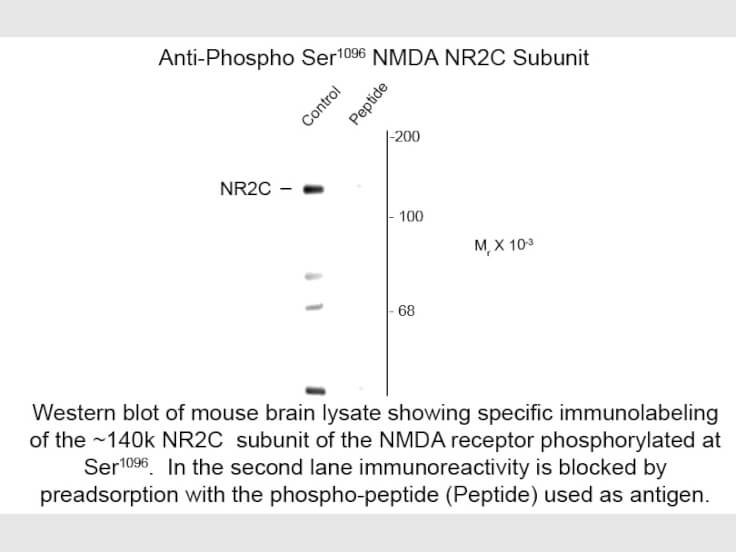
- NMDA R2C pS1096 antibody detects NMDA 2C receptor protein. The ion channels activated by glutamate that are sensitive to N-methyl-D-aspartate (NMDA) are designated NMDA receptors (NMDAR). The NMDAR plays an essential role in memory, neuronal development and it has also been implicated in several disorders of the central nervous system including Alzheimer's, epilepsy and ischemic neuronal cell death. The NMDA receptor is also one of the principal molecular targets for alcohol in the CNS. The NMDAR is also potentiated by protein phosphorylation. The NR2C subunit of the receptor is thought to influence the NMDAR conductance level. Phosphorylation of Ser1096 by PKB on NR2C has been recently demonstrated to regulate NMDA receptor binding to 14-3-3. Anti-NMDA R2C pS1096 antibody is ideal for investigators involved in Cell Signaling, Neuroscience, and Signal Transduction research.
- Shipping Conditions:
- Dry Ice