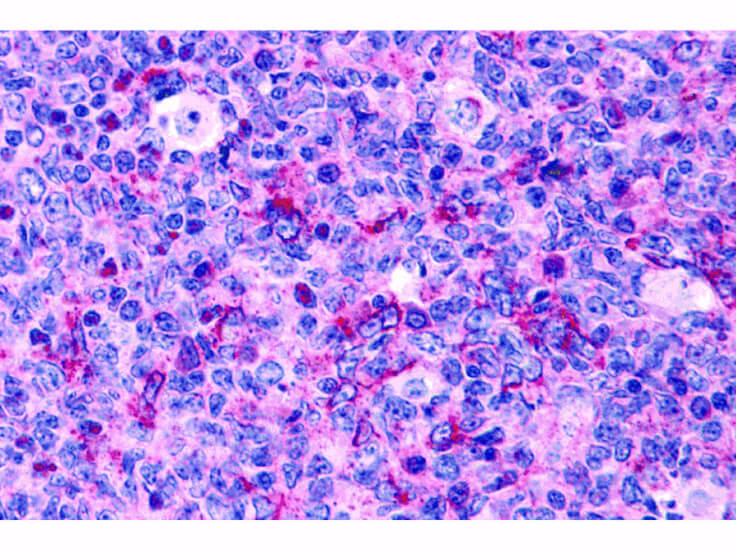
600-401-AD2
Caspase-3 Antibody

Cannot supply to this region.
- SKU:
- 600-401-AD2
- Additional Names:
- CASP3|Caspase-3 Antibody, CPP32, SCA-1, CPP32B, CPP32, Caspase-3, Apopain, CASP-3
- Application:
- ELISA, IHC
- Concentration:
- 1 mg/ml
- Physical State:
- Liquid
- Species Reactivity:
- Human
- Storage Conditions:
- -20[o]C aliquoted. Aliquot. Avoid freeze/thaw cycles., 2-8[o]C diluted. Aliquot. Avoid freeze/thaw cycles.
- Supplier:
- Rockland Inc
- Host:
- Rabbit
- Reactivities:
- Human
- Buffer:
- 0.01 M Sodium Phosphate, 0.25 M Sodium Chloride
- Immunogen:
- Anti-Caspase-3 antibody was prepared from whole rabbit serum produced by repeated immunizations with a 17 amino acid synthetic peptide near the internal region of human Caspase-3.
- Formulation:
- 0.01 M Sodium Phosphate, 0.25 M Sodium Chloride, pH 7.2
- Uniprot:
- P42574
- Synonyms:
- apopain;CASP-3;caspase 3, apoptosis-related cysteine peptidase;caspase 3, apoptosis-related cysteine protease;caspase-3;CPP-32;CPP32;CPP32B;cysteine protease CPP32;PARP cleavage protease;procaspase3;protein Yama;SCA-1;SREBP cleavage activity 1
- Extra Details:
- Caspases are a family of cysteine proteases that can be divided into the apoptotic and inflammatory caspase subfamilies. Unlike the apoptotic caspases, members of the inflammatory subfamily are generally not involved in cell death but are associated with the immune response to microbial pathogens. The apoptotic subfamily can be further divided into initiator caspases, which are activated in response to death signals, and executioner caspases, which are activated by the initiator caspases and are responsible for cleavage of cellular substrates that ultimately lead to cell death. Caspase-3 is synthesized as an inactive proenzyme that undergoes proteolytic cleavage by caspases 8, 9 and 10 to produce 2 subunits, termed p20 and p11. These subunits dimerize to form the active enzyme. Caspase-3 proteolytically cleaves and activates other proteins such as caspases 6, 7 and 9.
- Shipping Conditions:
- Dry Ice