600-401-974
AHA1 Antibody

Cannot supply to this region.
- SKU:
- 600-401-974
- Additional Names:
- AHSA1|rabbit anti-AHA1 Antibody, Aha-1, Aha 1, Ahsa1 antibody, Activator of Hsp90 ATPase, Activator of 90 kDa heat shock protein ATPase homolog 1 antibody
- Application:
- ELISA, IHC, WB, IP
- Concentration:
- 1 mg/ml
- Physical State:
- Liquid
- Species Reactivity:
- Human
- Storage Conditions:
- -20[o]C aliquoted. Aliquot. Avoid freeze/thaw cycles., 2-8[o]C diluted. Aliquot. Avoid freeze/thaw cycles.
- Supplier:
- Rockland Inc
- Host:
- Rabbit
- Reactivities:
- Human
- Buffer:
- 0.02 M Potassium Phosphate, 0.15 M Sodium Chloride
- Immunogen:
- This affinity purified antibody was prepared from whole rabbit serum produced by repeated immunizations with a synthetic peptide corresponding to an internal region of human AHA1 protein.
- Formulation:
- 0.02 M Potassium Phosphate, 0.15 M Sodium Chloride, pH 7.2
- Uniprot:
- O95433
- Synonyms:
- activator of 90 kDa heat shock protein ATPase homolog 1;AHA1;AHA1, activator of heat shock 90kDa protein ATPase homolog 1;C14orf3;hAha1;p38
- Extra Details:
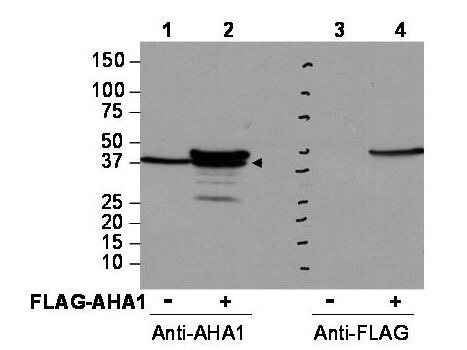
- This antibody is designed, produced, and validated as part of a collaboration between Rockland and the National Cancer Institute (NCI) and is suitable for Cancer, Immunology and Nuclear Signaling research. Activator of Hsp90 ATPase (AHA1) stimulates the inherent ATPase cycle of Hsp90, which is essential for its chaperone activity in vivo. The activation and/or stability of many of the key regulatory and signaling proteins of the eukaryotic cell depend on their interaction with the Hsp90 molecular chaperone. Hsp90 is assisted and regulated by co-chaperones that participate in an ordered series both to assist client-protein recruitment or release and to modulate progress through the ATPase coupled chaperone cycle. Structural analysis and mutagenesis show that binding of the N-terminal domain of AHA1 to Hsp90 promotes a conformational switch in the middle-segment catalytic loop (aa 370-390) of Hsp90 that exposes the catalytic Arg380 and enables its interaction with ATP in the N-terminal nucleotide-binding domain of the chaperone. Recent studies show that AHA1 modulates Hsp90-dependent stability of the folding of the cystic fibrosis transmembrane conductance regulator (CFTR) in the endoplasmic reticulum (ER). Down-regulation of AHA1 rescues misfolding of CFTR in cystic fibrosis.
- Shipping Conditions:
- Dry Ice