600-401-413
PAK 1/2/3 phospho T423 Antibody

Cannot supply to this region.
- SKU:
- 600-401-413
- Additional Names:
- PAK1|rabbit anti-PAK pT423 antibody, rabbit anti-PAK1/2/3 pT423 antibody, PAK1, PAK-1, PAK 1, Alpha PAK, p21-activated kinase 1, p65-PAK, PAK2, PAK-2, PAK 2, PAK65, S6/H4 kinase, p21-activated kinase 2, p58, Gamma PAK, PAK3, PAK-3, PAK 3, Beta PAK, CDC42/RAC effector kinase PAK-B, p21-activated kinase 3
- Application:
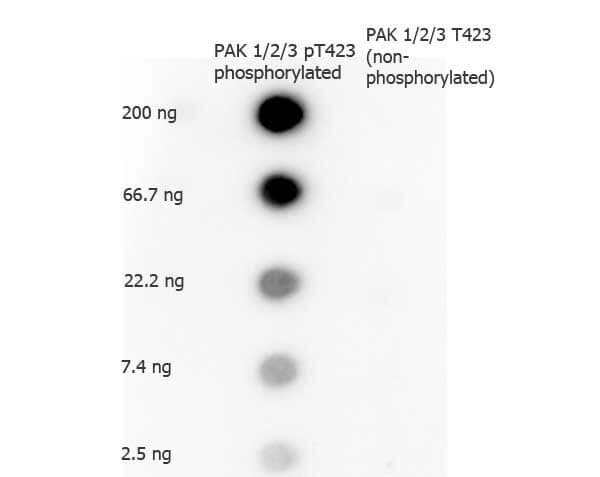
- ELISA, WB, Dot blot
- Concentration:
- 1 mg/ml
- Physical State:
- Liquid
- Species Reactivity:
- Human
- Storage Conditions:
- -20[o]C aliquoted. Aliquot. Avoid freeze/thaw cycles., 2-8[o]C diluted. Aliquot. Avoid freeze/thaw cycles.
- Supplier:
- Rockland Inc
- Host:
- Rabbit
- Reactivities:
- Human
- Buffer:
- 0.02 M Potassium Phosphate, 0.15 M Sodium Chloride
- Immunogen:
- Human PAK 1/2/3 phospho peptide corresponding to a region of the human protein conjugated to Keyhole Limpet Hemocyanin (KLH).
- Formulation:
- 0.02 M Potassium Phosphate, 0.15 M Sodium Chloride, pH 7.2
- Uniprot:
- Q13153
- Synonyms:
- alpha-PAK;IDDMSSD;p21 protein (Cdc42/Rac)-activated kinase 1;p21-activated kinase 1;p21/Cdc42/Rac1-activated kinase 1 (STE20 homolog, yeast);p21/Cdc42/Rac1-activated kinase 1 (yeast Ste20-related);p65-PAK;PAKalpha;serine/threonine-protein kinase PAK 1;STE20 homolog, yeast
- Extra Details:
- The p21-activated kinases (PAKs) are a family of multifunctional serine/threonine kinases involved in a variety of cell functions including stress response, apoptosis and regulation of cell motility and tumor metastasis. Mammalian PAKs are called 1, 2, 3 or a, g, b respectively. PAKs are part of a large family of kinases where the catalytic domain of the kinase is related to Ste20 kinase of S. cerevisiae. Pak activity is regulated by specific binding of GTP-bound Rac and cdc42 GTPases and also by sphingosine and related lipids. PAK1 activation is induced by a variety of growth factors and G-protein-coupled receptors, Fc receptors, and integrins. This antibody is specific for the phosphorylated form of PAK 1/2/3. The selected peptide sequence used to generate the polyclonal antibody is common to all human PAKs.
- Shipping Conditions:
- Dry Ice