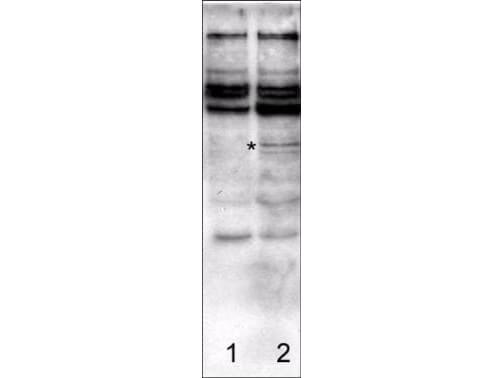
600-401-412
Caspase-2 Antibody

Cannot supply to this region.
- SKU:
- 600-401-412
- Additional Names:
- Casp2|rabbit anti-Caspase-2 Antibody, Apoptosis related cysteine peptidase antibody, CASP-2, CASP 2 antibody, Casp 2L Pro antibody, CASP2 antibody, Caspase 2 apoptosis related cysteine protease antibody, Caspase2 antibody, Caspase-2, Developmentally down regulated 2 antibody, ICH 1 antibody, ICH-1, Caspase-2 subunit p18, Caspase-2 subunit p13, Caspase-2 subunit p12
- Application:
- ELISA, WB
- Concentration:
- 0.44 mg/ml
- Physical State:
- Liquid
- Species Reactivity:
- Rat
- Storage Conditions:
- -20[o]C aliquoted. Aliquot. Avoid freeze/thaw cycles., 2-8[o]C diluted. Aliquot. Avoid freeze/thaw cycles.
- Supplier:
- Rockland Inc
- Host:
- Rabbit
- Reactivities:
- Mouse, Rat
- Buffer:
- 0.02 M Potassium Phosphate, 0.15 M Sodium Chloride
- Immunogen:
- A synthetic peptide corresponding to the N-terminus of rat Caspase-2 protein conjugated to Keyhole Limpet Hemocyanin (KLH) through a cysteine residue linker.
- Formulation:
- 0.02 M Potassium Phosphate, 0.15 M Sodium Chloride, pH 7.2
- Uniprot:
- P55215
- Synonyms:
- CASP-2;caspase-2;ICH-1 protease;protease ICH-1
- Extra Details:
- Apoptosis occurs during normal cellular development and involves dramatic changes in cellular structure. Disruption of apoptosis may contribute to cancer and other diseases. Caspases are a family of cysteine proteases that are key mediators of programmed cell death or apoptosis. Caspase-2 has been called ICH-1 in human, CED-3 in C.elegans and NEDD-2 in mouse. Caspase-2 is synthesized as an inactive precursor that is processed in cells undergoing apoptosis. The precursor form of all caspases is composed of a pro-domain, and large and small catalytic subunits. The active forms of caspases are generated by several stimuli, including ligand-receptor interactions, growth factor deprivation and inhibitors of cellular functions. Caspase-2 is activated in vitro by caspase-1, caspase-3 and granzyme B. Caspase-2 functions as an upstream apoptosis initiator that participates in the activation of downstream caspases, such as caspase-3, caspase-6 and caspase-7. Caspase-2 is highly expressed in embryonic mouse brain but not in adult neural tissue. Alternative mRNA splicing produces a long (48 kDa) and short (35 kDa) form of caspase-2. These forms show tissue specificity and function either as inducers or suppressors of apoptosis. Mature caspase-2 is 435 amino acids in length cleaved (~50 kDa) and is cleaved upon activation into 10 and 20 kDa subunits.
- Shipping Conditions:
- Dry Ice