600-401-271
NFkB p65 Antibody

Cannot supply to this region.
- SKU:
- 600-401-271
- Additional Names:
- rabbit anti-NFKB p65 antibody, rabbit anti-p65 antibody, rabbit anti-NLS specific antibody, nuclear localization sequence, NFKB, NFkB Beta, NF-kB, NF-kappaB, NFkappaB, Transcription factor p65, Nuclear factor NF-kappa-B p65 subunit, Nuclear factor of kappa light polypeptide gene enhancer in B-cells 3, RELA, NFKB3|RELA
- Application:
- ELISA, IHC, WB, IF
- Concentration:
- 1 mg/ml
- Physical State:
- Liquid
- Species Reactivity:
- Human
- Storage Conditions:
- -20[o]C aliquoted. Aliquot. Avoid freeze/thaw cycles., 2-8[o]C diluted. Aliquot. Avoid freeze/thaw cycles.
- Supplier:
- Rockland Inc
- Host:
- Rabbit
- Reactivities:
- Human
- Buffer:
- 0.02 M Potassium Phosphate, 0.15 M Sodium Chloride
- Immunogen:
- This antibody was purified from whole rabbit serum prepared by repeated immunizations with the NFkB p65 peptide corresponding to the NLS of the human protein conjugated to KLH using maleimide. A residue of cysteine was added to the amino terminal end to facilitate coupling.
- Formulation:
- 0.02 M Potassium Phosphate, 0.15 M Sodium Chloride, pH 7.2
- Uniprot:
- Q04206
- Synonyms:
- CMCU;NF-kappa-B p65delta3;NF-kappa-B transcription factor p65;NFKB3;nuclear factor NF-kappa-B p65 subunit;nuclear factor of kappa light polypeptide gene enhancer in B-cells 3;p65;transcription factor p65;v-rel avian reticuloendotheliosis viral oncogene homolog A
- Extra Details:
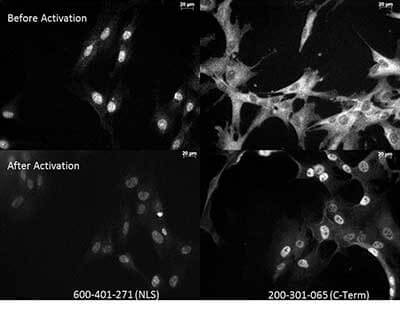
- NFkB was originally identified as a factor that binds to the immunoglobulin kappa light chain enhancer in B cells. It was subsequently found in non-B cells in an inactive cytoplasmic form consisting of NFkB bound to IkB. NFkB was originally identified as a heterodimeric DNA binding protein complex consisting of p65 (RelA) and p50 (NFKB1) subunits. Other identified subunits include p52 (NFKB2), c-Rel, and RelB. The p65, cRel, and RelB subunits are responsible for transactivation. The p50 and p52 subunits possess DNA binding activity but limited ability to transactivate. p52 has been reported to form transcriptionally active heterodimers with the NFkB subunit p65, similar to p50/p65 heterodimers. Low levels of p52 and p50 homodimers can also exist in cells. The heterodimers of p52/p65 and p50/p65 are regulated by physical inactivation in the cytoplasm by IkB-a. IkB-a binds to the p65 subunit, preventing nuclear localization and DNA binding. IkB-a binding masks the NFkB nuclear localization signal (NLS). A broad range of external stimuli lead to activation of NFkB and set off signaling cascades that ultimately converge on the IkB kinase (IKK) complex. Activated IKK specifically and directly phosphorylates IkB-a and this phosphorylation event targets IkB-a for degradation. As a consequence, NFkB NLS is uncovered and nuclear translocation occurs.
- Shipping Conditions:
- Dry Ice