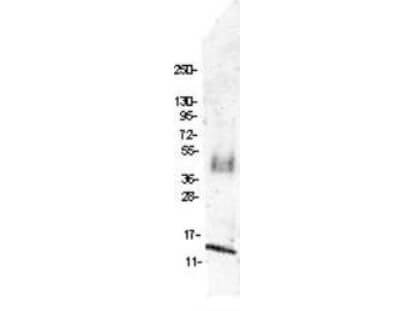
214-401-B85
MIP-1 beta Antibody

Cannot supply to this region.
- SKU:
- 214-401-B85
- Additional Names:
- CCL4|rabbit anti-MIP 1 beta Antibody, rabbit anti-MIP-1b Antibody, rabbit anti-CCL4 antibody, CCL4, C-C motif chemokine 4, Small-inducible cytokine A4, Macrophage inflammatory protein 1-beta, MIP-1-beta, ACT-2, MIP-1B Beta
- Application:
- ELISA, WB
- Concentration:
- 1 mg/ml
- Physical State:
- Liquid
- Species Reactivity:
- Porcine
- Storage Conditions:
- -20[o]C aliquoted. Aliquot. Avoid freeze/thaw cycles., 2-8[o]C diluted. Aliquot. Avoid freeze/thaw cycles.
- Supplier:
- Rockland Inc
- Host:
- Rabbit
- Reactivities:
- Porcine
- Buffer:
- 0.02 M Potassium Phosphate, 0.15 M Sodium Chloride
- Immunogen:
- This protein-A purified antibody was prepared from whole rabbit serum produced by repeated immunizations with recombinant protein raised in yeast, corresponding to the 69 amino acids of the mature swine CCL4/MIP1B Beta protein.
- Formulation:
- 0.02 M Potassium Phosphate, 0.15 M Sodium Chloride, pH 7.2
- Uniprot:
- Q711P4
- Synonyms:
- C-C motif chemokine 4;chemokine (C-C motif) ligand 4;macrophage inflammatory protein 1-beta;MIP-1-beta;MIP-1BETA;MIP1b;SCY4A;small-inducible cytokine A4
- Extra Details:
- In many species, both C-C chemokines macrophage inflammatory protein, or MIP-1 alpha (CCL3L1), and MIP-1 beta (CCL4) are structurally and functionally related CC chemokines. They are both potent chemoattractants for monocytes, which form an important component of the stroma of tumor tissue, and in humans may regulate tumor growth and associated inflammation. They participate in the host response to invading bacterial, viral, parasite and fungal pathogens by regulating the trafficking and activation state of selected subgroups of inflammatory cells e.g. macrophages, lymphocytes and NK cells. Both MIP-1 alpha and MIP-1 beta exert similar effects on monocytes, but their effect on lymphocytes differ. MIP-1 alpha selectively attracts CD8+ lymphocytes, while MIP-1 beta selectively attracts CD4+ lymphocytes. They contain the four highly conserved cysteine residues present in CC chemokines. MIP-1 beta (CCL4) has specificity for CCR5 receptors. In humans, it is also a major HIV-suppressive factor produced by CD8+ T cells.
- Shipping Conditions:
- Ambient