209-301-E62S
BIN1 Antibody

Cannot supply to this region.
- SKU:
- 209-301-E62S
- Additional Names:
- AMPHL, Myc box-dependent-interacting protein 1, Amphiphysin II, Amphiphysin-like protein, Box-dependent myc-interacting protein 1, Bridging integrator 1, BIN 1, BIN-1, mouse anti-BIN1 antibody, anti-BIN1 antibody|BIN1
- Application:
- ELISA, WB
- Concentration:
- 1 mg/ml
- Physical State:
- Liquid
- Species Reactivity:
- Human
- Storage Conditions:
- -20[o]C diluted. Avoid freeze/thaw cycles., See Manual Avoid freeze/thaw cycles.
- Supplier:
- Rockland Inc
- Host:
- Mouse
- Reactivities:
- Human
- Buffer:
- 0.02 M Potassium Phosphate, 0.15 M Sodium Chloride
- Immunogen:
- Anti-BIN1 (MOUSE) Monoclonal Antibody was produced in mouse by repeated immunizations with 12A exon BIN1 protein followed by hybridoma development.
- Formulation:
- 0.02 M Potassium Phosphate, 0.15 M Sodium Chloride, pH 7.2
- Clone:
- 12A
- Uniprot:
- O00499
- Synonyms:
- AMPH2;amphiphysin II;amphiphysin-like protein;AMPHL;box dependant MYC interacting protein 1;box-dependent myc-interacting protein 1;Bridging integrator 1;CNM2;myc box-dependent-interacting protein 1;SH3P9
- Extra Details:
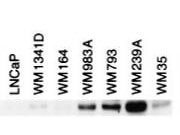
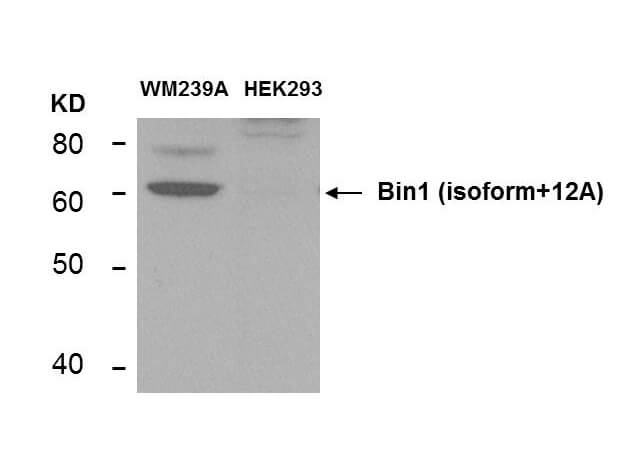
- Bin1 is a conserved member of the BAR family of genes that have been implicated in diverse cellular processes including endocytosis, actin organization, programmed cell death, stress responses, and transcriptional control. The first mammalian BAR protein to be discovered, Amphiphysin I (AmphI), was identified in an immunoscreen for proteins associated with the plasma membranes of synaptic neurons, functions in the control of clathrin-dependent synaptic vesicle endocytosis. The mammalian Bin1 gene was first identified in a two hybrid screen for polypeptides that bind to the N-terminal Myc box 1 (MB1) portion of the c-Myc oncoprotein. Bin1 is similar to AmphI in overall structure, with an N-terminal BAR domain and a C-terminal SH3 domain. However, the Bin1 gene is more complex than the AmphI gene, encoding at least seven different splice variants that differ widely in subcellular localization, tissue distribution, and ascribed functions. Alternate splicing of the Bin1 gene results in ten transcript variants encoding different isoform. Bin1 is expressed ubiquitously in mammalian cells. Certain splice variants of Bin1 are expressed in the neurons, muscle cells or tumor cells. Bin1 may act with cancer suppressor and inhibits malignant cell transformation. A Study in human tumor cell lines found that most melanoma cells inappropriately expressed exon 12A, suggests that the aberrant splicing of Bin1 may contribute to melanoma progression.
- Shipping Conditions:
- Dry Ice