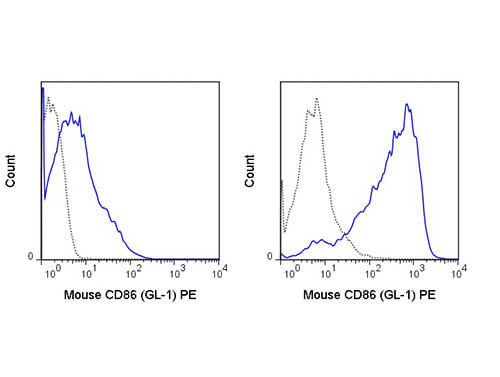
200-508-N90
CD86 Phycoerythrin Antibody

Cannot supply to this region.
- SKU:
- 200-508-N90
- Additional Names:
- Cd86|T-lymphocyte activation antigen CD86, Activation B7-2 antigen, Early T-cell costimulatory molecule 1, ETC-1, CD86, Cd86
- Application:
- Flow Cytometry, IHC, IF
- Concentration:
- 0.2 mg/ml
- Physical State:
- Liquid
- Species Reactivity:
- Mouse
- Storage Conditions:
- 2-8[o]C unopened. Protect from light.
- Supplier:
- Rockland Inc
- Host:
- Rat
- Reactivities:
- Mouse
- Buffer:
- 0.01 M Sodium Phosphate, 0.15 M Sodium Chloride
- Immunogen:
- Anti-CD86 Antibody (Monoclonal) was produced by repeated immunizations with CD86 antigen.
- Formulation:
- 0.01 M Sodium Phosphate, 0.15 M Sodium Chloride, pH 7.2
- Clone:
- GL-1
- Uniprot:
- P42082
- Synonyms:
- activation B7-2 antigen;B7;B7-2;B7.2;B70;Cd28l;Cd28l2;CLS1;early T cell costimulatory molecule-1;Early T-cell costimulatory molecule 1;ETC-1;Ly-5;Ly-58;Ly5;Ly58;MB7;MB7-2;T-lymphocyte activation antigen CD86;TS/A-2
- Extra Details:
- Anti-CD86 reacts with mouse CD86, also known as B7-2, an 80 kDa cell surface protein which is a ligand for CD28, a co-stimulatory receptor for the T cell receptor (TCR). CD28 can also bind a second B7 ligand known as CD80 (B7-1). Both CD80 and CD86 are expressed on activated B cells and antigen-presenting cells. These ligands trigger CD28 signaling in concert with TCR activation to drive T cell proliferation, induce high-level expression of IL-2, impart resistance to apoptosis, and enhance T cell cytotoxicity. The interaction / co-stimulatory signaling between the B7 ligands and CD28 provides crucial communication between T cells and B cells or APCs to coordinate the adaptive immune response. The GL-1 antibody may be used as a marker for CD86 expression on B cells, macrophages, and dendritic cells.
- Shipping Conditions:
- Blue Ice