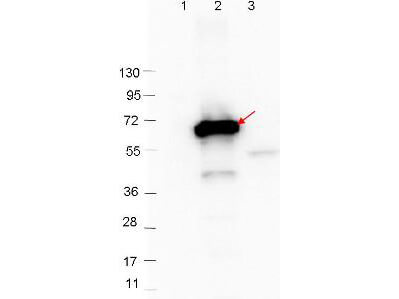
200-401-C19S
CRASP-2 Antibody

Cannot supply to this region.
- SKU:
- 200-401-C19S
- Additional Names:
- cspZ, BB_H06|rabbit anti-CRASP-2 Antibody, Borrelia burgdorferi CRASP-2, CRASP2, CRASP 2
- Application:
- ELISA, WB
- Concentration:
- 1.1 mg/ml
- Physical State:
- Liquid
- Species Reactivity:
- Bacteria
- Storage Conditions:
- -20[o]C diluted. Avoid freeze/thaw cycles., See Manual Avoid freeze/thaw cycles.
- Supplier:
- Rockland Inc
- Host:
- Rabbit
- Reactivities:
- Bacteria
- Buffer:
- 0.02 M Potassium Phosphate, 0.15 M Sodium Chloride
- Immunogen:
- MBP-fusion protein corresponding to Borrelia burgdorferi CRASP-2 protein.
- Formulation:
- 0.02 M Potassium Phosphate, 0.15 M Sodium Chloride, pH 7.2
- Uniprot:
- O50665
- Synonyms:
- BB_H06;BB_RS04320;factor H-binding protein CspZ
- Extra Details:
- CRASP-2 (Complement Regulator-Acquiring Surface Protein 2) of Borrelia burgdorferi binds FHL-1 and factor H binding protein in a distinct way. It may be predominantly expressed by serum-resistant Borrelia strains. Borrelia burgdorferi sensu lato has the ability to evade immune systems to persist in a variety of vertebrate hosts. This activity is dependent on a number of factors. Some Borrelia species bind host-derived fluid-phase immune regulators FHL-1 and factor H to their surface via complement regulator-acquiring surface proteins (CRASPs). Factor H and FHL-1 serve as cofactors for factor I, a serine protease that cleaves complement component 3b (C3b) directly on the cell surface and thereby confers resistance of spirochetes to complement-mediated lysis. It is possible that because of discontinuous binding regions in the factor H/FHL-1, long distance interaction may be involved in binding of both immune regulators. Putative coiled-coil structural elements may be important in the interaction of B. burgdorferi CRASP-1 with factor H.
- Shipping Conditions:
- Dry Ice