200-401-B91
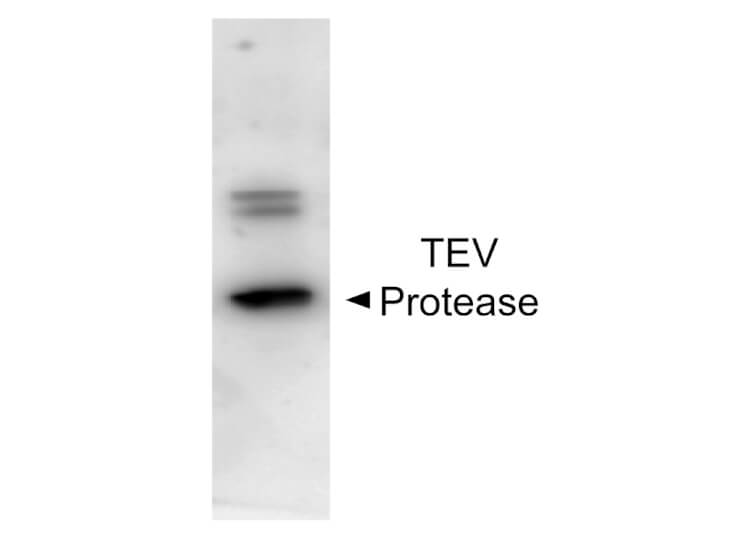
TEV Protease Antibody

Cannot supply to this region.
- SKU:
- 200-401-B91
- Additional Names:
- rabbit anti-TEV Protease Antibody, Tobacco Etch Virus, tobacco etch potyvirus, TEV, TEV Protease
- Application:
- ELISA, WB
- Concentration:
- 1.01 mg/ml
- Physical State:
- Liquid
- Species Reactivity:
- Virus
- Storage Conditions:
- -20[o]C aliquoted. Aliquot. Avoid freeze/thaw cycles., 2-8[o]C diluted. Aliquot. Avoid freeze/thaw cycles.
- Supplier:
- Rockland Inc
- Host:
- Rabbit
- Buffer:
- 0.02 M Potassium Phosphate, 0.15 M Sodium Chloride
- Immunogen:
- This protein-A purified antibody was prepared from whole rabbit serum produced by repeated immunizations with recombinant MBP-and-poly-His-tagged auto inactivation-resistant mutant TEV Protease.
- Formulation:
- 0.02 M Potassium Phosphate, 0.15 M Sodium Chloride, pH 7.2
- Uniprot:
- P04517
- Synonyms:
- polyprotein;TEVgp1
- Extra Details:
- TEV protease, encoded by the Tobacco Etch Virus (TEV), is a 27 kDa catalytic domain of the Nuclear Inclusion a (NIa) protein encoded by the virus (TEV). It is widely used for cleaving fusion proteins because of its sequence specificity. It recognizes a linear epitope of the general form E-Xaa-Xaa-Y-Xaa-Q-(G/S). Cleavage occurs between Q and G or Q and S. The structure of TEV protease is similar to that of the serine protease family. Like serine proteases, TEV protease utilizes a catalytic triad of residues to hydrolyze peptide bonds. The distinguishing feature of TEV protease, however, is that instead of the serine nucleophile in the triad Ser-Asp-His, there is a cysteine, which may explain the resistance of TEV protease to protease inhibitors which are commonly used. The strain used is the auto inactivation-resistant mutant S219V. The catalytic activity of the S219V mutant is approximately 2 fold greater than that of the wild-type protease.
- Shipping Conditions:
- Dry Ice