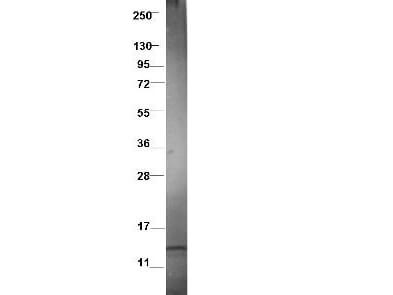
200-401-B61
CCL3L1 Antibody

Cannot supply to this region.
- SKU:
- 200-401-B61
- Additional Names:
- CCL3L1|rabbit anti-CCL3L1 Antibody, CCL3L3, Chemokine (C-C motif) ligand 3-like 1, macrophage inflammatory protein 1 alpha, MIP-1 alpha, ld78beta, scya3l1, small inducible cytokine a3-like 1
- Application:
- ELISA, WB
- Concentration:
- 1 mg/ml
- Physical State:
- Lyophilized
- Species Reactivity:
- Porcine
- Purity:
- >90%
- Storage Conditions:
- 2-8[o]C liquid. Aliquot. Avoid freeze/thaw cycles., -20[o]C/-70[o]C aliquoted. Aliquot. Avoid freeze/thaw cycles.
- Supplier:
- Rockland Inc
- Host:
- Rabbit
- Reactivities:
- Bovine, Porcine
- Buffer:
- 0.02 M Potassium Phosphate, 0.15 M Sodium Chloride
- Immunogen:
- This protein-A purified antibody was prepared from whole rabbit serum produced by repeated immunizations with a recombinant protein raised in yeast, corresponding to the 70 amino acids of the mature swine CCL3L1 protein.
- Formulation:
- 0.02 M Potassium Phosphate, 0.15 M Sodium Chloride, pH 7.2
- Uniprot:
- A1YM34
- Synonyms:
- C-C motif chemokine 3-like 1;chemokine ligand 3-like 1;macrophage inflamatory protein 1 alpha
- Extra Details:
- Chemokine (C-C motif) ligand 3-like 1 (CCL3L1), also known as macrophage inflammatory protein 1 alpha (MIP-1 alpha; other synonyms: ld78beta, scya3l1, small inducible cytokine a3-like 1), is a member of the CC or beta chemokine subfamily that was originally purified from the conditioned media of an LPS-stimulated murine macrophage cell line. In humans, CCL3L1 is encoded by a variable copy-number gene. The CC family induces MCP1 and RANTES, and exhibits a variety of proinflammatory activities including chemotaxis, and functional and proliferative activation of leukocytes, lymphocytes, and macrophages. Its signal is transmitted through transmembrane receptors, CC chemokine receptors, CCR1, CCR3 and CCR5. CCL3L1/MIP-1 alpha acts as a chemoattractant to a variety of cells including monocytes, T cells, B cells and eosinophils. CCL3L1 binds to several chemokine receptors. In humans these receptors include chemokine binding protein 2 and chemokine (C-C motif) receptor 5 (CCR5). CCR5 is a co-receptor for HIV, and binding of this protein to CCR5 inhibits HIV entry. In swine, CCL3L1 protein is 86% similar to CCL4 protein, and 73% similar to CCL5.
- Shipping Conditions:
- Ambient