200-401-B55
IL13 Antibody

Cannot supply to this region.
- SKU:
- 200-401-B55
- Additional Names:
- IL13|rabbit anti-Interleukin-13 antibody, rabbit anti-IL-13 antibody, IL13, Interleukin13, IL 13, Interleukin 13
- Application:
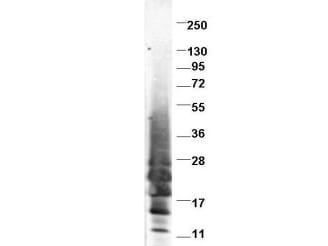
- ELISA, WB
- Concentration:
- 1 mg/ml
- Physical State:
- Lyophilized
- Species Reactivity:
- Porcine
- Storage Conditions:
- 2-8[o]C liquid. Aliquot. Avoid freeze/thaw cycles., -20[o]C/-70[o]C aliquoted. Aliquot. Avoid freeze/thaw cycles.
- Supplier:
- Rockland Inc
- Host:
- Rabbit
- Reactivities:
- Bovine, Porcine, Ovine
- Buffer:
- 0.02 M Potassium Phosphate, 0.15 M Sodium Chloride
- Immunogen:
- This protein-A purified antibody was prepared from whole rabbit serum produced by repeated immunizations with full length recombinant protein raised in yeast, corresponding to mature swine IL-13 protein.
- Formulation:
- 0.02 M Potassium Phosphate, 0.15 M Sodium Chloride, pH 7.2
- Uniprot:
- B3GDZ5
- Synonyms:
- IL-13;interleukin-13;L13
- Extra Details:
- Interleukin 13 (IL-13), of the IL-4 superfamily, is a cytokine secreted by many cell types, but especially T helper type 2 (Th2) cells, that is an important mediator of allergic inflammation and disease. IL-13 induces its effects through a multi-subunit receptor that includes the alpha chain of the IL-4 receptor (IL-4RA Alpha) and at least one IL-13-specific binding chain. Most of the biological effects of IL-13, like those of IL-4, are linked to a single transcription factor, STAT6. In humans, IL-13 can induce immunoglobulin E (IgE) secretion from activated B cells. In mice, deletion of IL-13 does not markedly affect either Th2 cell development or antigen-specific IgE responses induced by potent allergens. Deletion of IL-4 abrogates these responses. IL-13 acts as a molecular bridge linking allergic inflammatory cells to the non-immune cells in contact with them, thus altering physiological function. Although IL-13 is associated primarily with the induction of airway disease, including airway hyperresponsiveness, goblet cell metaplasia and mucus hypersecretion, it also induces airway matrix metalloproteinases as part of a mechanism that protects against excessive allergic inflammation that predisposes to asphyxiation. Anti-IL-13 antibody is ideal for investigators involved in Cancer and Immunology research.
- Shipping Conditions:
- Ambient