200-401-990
UPLC1/ASAP3 Antibody

Cannot supply to this region.
- SKU:
- 200-401-990
- Additional Names:
- ASAP3|rabbit anti-UPLC1 Antibody, rabbit anti-ASAP3 Antibody, UPLC1/ASAP3 Antibody, Arf-GAP with SH3 domain, ANK repeat and PH domain-containing protein 3, FLJ20199 antibody, Gm140 antibody, Development and differentiation-enhancing factor-like 1, Protein up-regulated in liver cancer 1, DDEFL1
- Application:
- ELISA, WB
- Concentration:
- 1.1 mg/ml
- Physical State:
- Liquid
- Species Reactivity:
- Human
- Storage Conditions:
- 2-8[o]C Aliquot. Avoid freeze/thaw cycles. Store undiluted., -20[o]C Aliquot. Avoid freeze/thaw cycles. Store undiluted.
- Supplier:
- Rockland Inc
- Host:
- Rabbit
- Reactivities:
- Human
- Buffer:
- 0.02 M Potassium Phosphate, 0.15 M Sodium Chloride
- Immunogen:
- This antibody was prepared from whole rabbit serum produced by repeated immunizations with recombinant human UPLC1/ASAP3 protein.
- Formulation:
- 0.02 M Potassium Phosphate, 0.15 M Sodium Chloride, pH 7.2
- Uniprot:
- Q8TDY4
- Synonyms:
- ACAP4;arf-GAP with SH3 domain, ANK repeat and PH domain-containing protein 3;ARF6 GTPase-activating protein;ArfGAP with SH3 domain, ankyrin repeat and PH domain 3 1;centaurin, beta 6;CENTB6;DDEFL1;development and differentiation enhancing factor-like 1;Development and differentiation-enhancing factor-like 1;protein up-regulated in liver cancer 1;up-regulated in liver cancer 1 (UPLC1);UPLC1
- Extra Details:
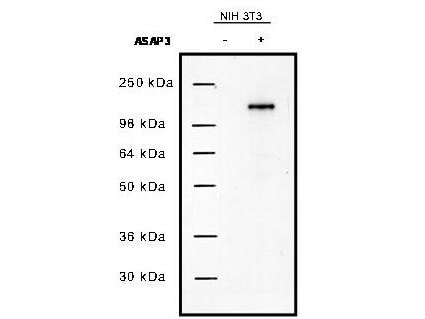
- This antibody is designed, produced, and validated as part of a collaboration between Rockland and the National Cancer Institute (NCI) and is suitable for Cancer, Immunology and Nuclear Signaling research. Anti-UPLC1 (up-regulated in liver cancer 1) / ASAP3 Antibody, also named DDEFL1 (development and differentiation-enhancing factor-like 1) or ASAP3, is a member of the AZAP family of proteins. These proteins catalyze the hydrolysis of GTP bound to ADP-ribosylation factor (Arf) proteins, thereby causing Arf inactivation. For this reason, the ASAPs are generally called ArfGAPs. The activity of ArfGAPs is dependent on the presence of phosphoinositides and is implicated in cellular processes such as membrane trafficking and remodeling of the actin cytoskeleton. ASAP3 has been found to be up-regulated in 80% of the hepatocellular carcinomas examined. Initial biochemical characterization reveals that ASAP3 shows class-specific GAP activity on Arf proteins, preferring Arf5 over Arf1 and Arf6. ASAP3 antibody has beed developed through the NCI antibody collaboration program and is ideal for Cancer and Signal Transduction research.
- Shipping Conditions:
- Dry Ice