200-308-N14
CD3 Phycoerythrin Antibody

Cannot supply to this region.
- SKU:
- 200-308-N14
- Additional Names:
- CD3E|T-cell surface glycoprotein CD3 epsilon chain, T-cell surface antigen T3/Leu-4 epsilon chain, CD3e
- Application:
- Flow Cytometry, IHC, WB, IP
- Concentration:
- 0.012 mg/ml
- Physical State:
- Liquid
- Species Reactivity:
- Human
- Storage Conditions:
- 2-8[o]C unopened. Protect from light.
- Supplier:
- Rockland Inc
- Host:
- Mouse
- Reactivities:
- Human
- Buffer:
- 0.01 M Sodium Phosphate, 0.15 M Sodium Chloride
- Immunogen:
- Anti-CD3 Antibody (Monoclonal) was produced by repeated immunizations with CD3 antigen.
- Formulation:
- 0.01 M Sodium Phosphate, 0.15 M Sodium Chloride, pH 7.2
- Clone:
- UCHT1
- Uniprot:
- P07766
- Synonyms:
- CD3-epsilon;CD3e antigen, epsilon polypeptide (TiT3 complex);CD3e molecule, epsilon (CD3-TCR complex);IMD18;T-cell antigen receptor complex, epsilon subunit of T3;T-cell surface antigen T3/Leu-4 epsilon chain;T-cell surface glycoprotein CD3 epsilon chain;T3E;TCRE
- Extra Details:
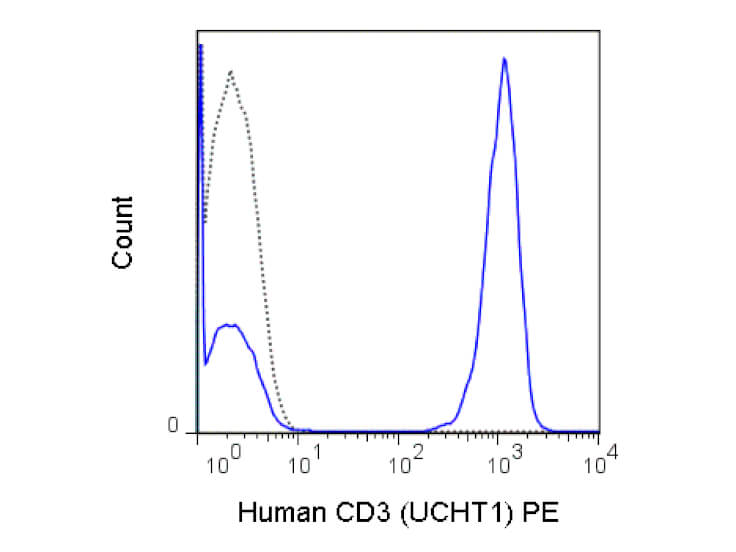
- The UCHT1 antibody is specific for human CD3e, also known as CD3 epsilon, a 20 kDa subunit of the T cell receptor complex, along with CD3 gamma and CD3 delta. These integral membrane protein chains assemble with additional chains of the T cell receptor (TCR), as well as CD3 zeta chain, to form the T cell receptor - CD3 complex. Together with co-receptors CD4 or CD8, the complex serves to recognize antigens bound to MHC molecules on antigen-presenting cells. These interactions promote T cell receptor signaling (T cell activation), inducing cell proliferation, differentiation, production of cytokines or activation-induced cell death. CD3 is differentially expressed during thymocyte-to-T cell development and on all mature T cells. The UCHT1 antibody is a widely used phenotypic marker for human T cells. In addition, binding/cross-linking of UCHT1 antibody to CD3e can induce cell activation. A recent publication of the crystal structure of a CD3e- antibody complex provides insight as to the action of commonly used agonist antibodies, as well as specific epitope-binding data for the human CD3 antibodies UCHT1 and OKT3. UCHT1 antibody reacts with both surface-expressed and intracellular CD3e protein, in contrast to an alternative human CD3 clone, HIT3a, which will stain only the extracellular (membrane-expressed) CD3e protein. Also, the UCHT1 antibody is reported to be cross-reactive with chimpanzee and has been used for phenotypic analysis of expression by flow cytometry; however the antibody is reported to be unsuitable for induction of T cell activation in this species.
- Shipping Conditions:
- Blue Ice