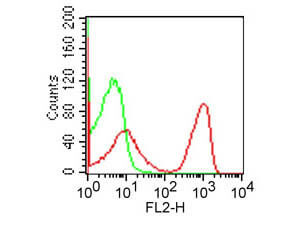
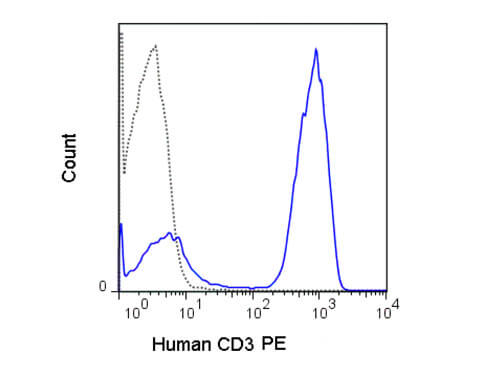
200-308-M62
CD3 Phycoerythrin Antibody

Cannot supply to this region.
- SKU:
- 200-308-M62
- Additional Names:
- CD3e|T-cell surface glycoprotein CD3 epsilon chain, T-cell surface antigen T3/Leu-4 epsilon chain, CD3e
- Application:
- Flow Cytometry
- Concentration:
- 0.1 mg/ml
- Physical State:
- Liquid
- Species Reactivity:
- Human
- Storage Conditions:
- 2-8[o]C unopened. Protect from light.
- Supplier:
- Rockland Inc
- Host:
- Mouse
- Reactivities:
- Human
- Buffer:
- 0.01 M Sodium Phosphate, 0.15 M Sodium Chloride
- Immunogen:
- Anti-CD3 Antibody (Monoclonal) was produced by repeated immunizations with CD3 antigen.
- Formulation:
- 0.01 M Sodium Phosphate, 0.15 M Sodium Chloride, pH 7.2
- Clone:
- OKT3
- Uniprot:
- P07766
- Synonyms:
- CD3-epsilon;CD3e antigen, epsilon polypeptide (TiT3 complex);CD3e molecule, epsilon (CD3-TCR complex);IMD18;T-cell antigen receptor complex, epsilon subunit of T3;T-cell surface antigen T3/Leu-4 epsilon chain;T-cell surface glycoprotein CD3 epsilon chain;T3E;TCRE
- Extra Details:
- CD3 (T3), a complex T cell marker, is known to associate noncovalently with the a/b or g/z heterodimer of the T cell antigen receptor (TCR) to form the most complex transmembrane (TM) receptor structures. Structurally, CD3 consists of four distinct membrane glycoprotein isoforms (CD3g, CD3e, CD3s and the zeta chain) to generate activation signals. CD3 is specially engaged in antigen recognition and is known to play an important role in mediating signals that are critical for T cell development in the thymus, proliferation, and induction of T cell-mediated immune responses against infectious agents and also in the differentiation of T cells into effector and memory populations. CD3 usually expresses in the cytoplasm of prothymocytes, and on the surface of about 95% of thymocytes, but cytoplasmic CD3 is lost as the cells differentiate into medullary thymocytes. Apart from its role as an important marker in the classification of malignant lymphomas and lymphoid leukaemia, CD3 can also be useful for the identification of T cells in celiac disease, lymphocytic colitis and colorectal carcinomas associated with loss of a mismatch repair protein. CD3 indirectly plays an important role in immunomodulation whereas the anti-CD3 antibody may be used in in vitro Treg assays to generate effector T cells.
- Shipping Conditions:
- Blue Ice