200-301-H56
ATF6 Antibody

Cannot supply to this region.
- SKU:
- 200-301-H56
- Additional Names:
- Activating transcription factor 6 alpha|ATF6
- Application:
- ChIP, Flow Cytometry, IHC, WB, IF, IP
- Concentration:
- 1 mg/ml
- Physical State:
- Liquid
- Species Reactivity:
- Human
- Storage Conditions:
- -20[o]C aliquoted. Aliquot. Avoid freeze/thaw cycles., 2-8[o]C diluted. Aliquot. Avoid freeze/thaw cycles.
- Supplier:
- Rockland Inc
- Host:
- Mouse
- Reactivities:
- Human, Mouse
- Buffer:
- 0.02 M Potassium Phosphate, 0.15 M Sodium Chloride
- Immunogen:
- ATF6 Antibody was produced in mice by repeated immunizations with the partial protein of human ATF6 at the n-terminus of the protein.
- Formulation:
- 0.02 M Potassium Phosphate, 0.15 M Sodium Chloride, pH 7.2
- Clone:
- 70B1413.1
- Uniprot:
- P18850
- Synonyms:
- ACHM7;Activating transcription factor 6 alpha;ATF6A;cAMP-dependent transcription factor ATF-6 alpha;cyclic AMP-dependent transcription factor ATF-6 alpha
- Extra Details:
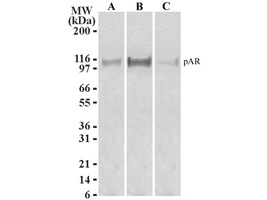
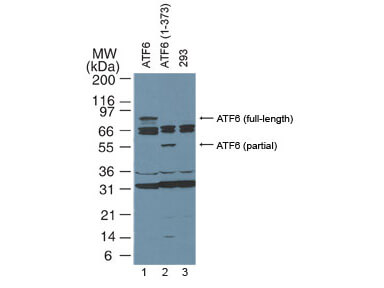
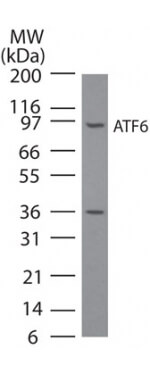
- Anti-ATF6 antibody detects human ATF6. ATF6 is a constitutively expressed, endoplasmic reticulum (ER) membrane-anchored transcription factor. ATF6 is a key transcriptional activator of the unfolded protein response (UPR), which allows mammalian cells to maintain cellular homeostasis when they are subjected to environmental and physiological stresses that target the ER. The C-terminus of ATF6 is located in the ER lumen and its N-terminal DNA binding domain faces the cytosol. AFT6 plays a key role in the ER stress response by transmitting the ER stress signal across the ER membrane into the nucleus. The induction of new gene expression by ATF6 is an important aspect of the ER stress response. In response to certain stress conditions, ATF6 translocates from the ER to the Golgi. The 90 kDa full-length ATF6 is processed within the Golgi to its active 50 kDa form through sequential cleavage by site-1 and site-2 proteases (S1P and S2P). Proteolytic activation of ATF6 in the ER stress response is a mechanism to regulate membrane-bound factors, and is referred to as regulated intramembrane proteolysis. The N-terminal active ATF6 translocates to the nucleus where it binds to ER stress-response elements in ER stress-response genes (ERSRGs). ATF6 is a potent transcriptional activator of ERSRGs. The fully glycosylated form of ATF6, a 670 amino acid protein, exhibits an electrophoretic mobility of ~90 kDa in denaturing SDS-gels, in part because of the glycosylated modifications. ATF6 has 3 consensus sites for N-linked glycosylation and exists constitutively as a glycosylated protein. Differentially glycosylated ATF6 forms may result from mutations or experimental treatment. Anti-ATF6 antibody is ideal for investigators involved in apoptosis research.
- Shipping Conditions:
- Dry Ice