200-301-F75
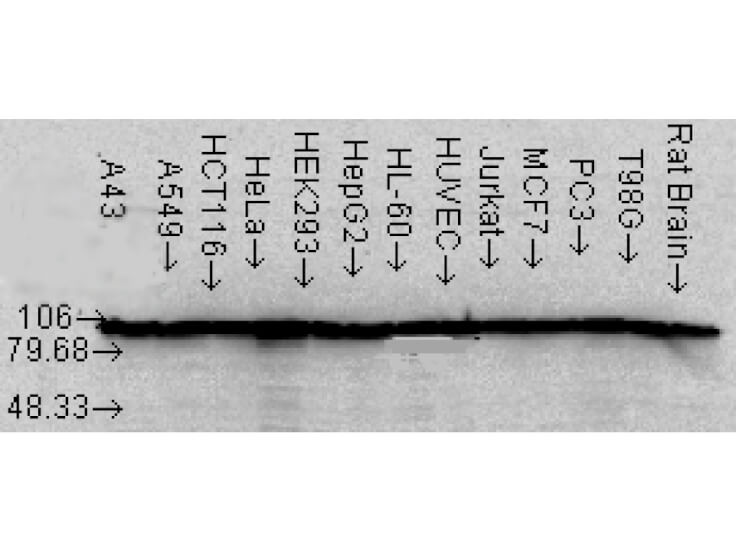
HSP90 alpha/beta Antibody

Cannot supply to this region.
- SKU:
- 200-301-F75
- Additional Names:
- Anti-Hsp90A AlphaB Beta, Hsp86, Hsp89A, Hsp90AA1, Hsp90Alpha, HspC1, HSPCA, HspCAL3, Heat shock protein HSP 90-alpha, Heat shock 86 kDa, HSP 86, HSP86, Renal carcinoma antigen NY-REN-38, HSP90AA1, HSP90A, HSPC1, HSPCA|HSP90AA1
- Application:
- ELISA, IHC, WB, IF
- Concentration:
- 1 mg/ml
- Physical State:
- Liquid
- Species Reactivity:
- Human
- Storage Conditions:
- -20[o]C aliquoted. Aliquot. Avoid freeze/thaw cycles., 2-8[o]C diluted. Aliquot. Avoid freeze/thaw cycles.
- Supplier:
- Rockland Inc
- Host:
- Mouse
- Reactivities:
- Human, Rat, Yeast
- Buffer:
- 0.02 M Potassium Phosphate, 0.15 M Sodium Chloride
- Immunogen:
- Hsp90 alpha beta Antibody was produced in mice by repeated immunizations raised against recombinant human Hsp90alpha.
- Formulation:
- 0.02 M Potassium Phosphate, 0.15 M Sodium Chloride, pH 7.2
- Clone:
- Hyb-K41220A
- Uniprot:
- P07900
- Synonyms:
- EL52;epididymis luminal secretory protein 52;epididymis secretory sperm binding protein Li 65p;heat shock 86 kDa;heat shock 90kD protein 1, alpha;heat shock 90kD protein 1, alpha-like 4;heat shock 90kD protein, alpha-like 4;heat shock 90kDa protein 1, alpha;heat shock protein 90kDa alpha (cytosolic), class A member 1;heat shock protein 90kDa alpha family class A member 1;heat shock protein HSP 90-alpha;HEL-S-65p;HSP 86;Hsp103;HSP86;Hsp89;HSP89A;Hsp90;HSP90A;HSP90N;HSPC1;HSPCA;HSPCAL1;HSPCAL4;HSPN;LAP-2;LAP2;lipopolysaccharide-associated protein 2;LPS-associated protein 2;renal carcinoma antigen NY-REN-38
- Extra Details:
- HSP90 is an abundantly and ubiquitously expressed heat shock protein. It is understood to exist in two principal forms A Alpha and B Beta, which share 85% sequence amino acid homology. The two isoforms of Hsp90 are expressed in the cytosolic compartment. Despite the similarities, HSP90A Alpha exists predominantly as a homodimer while HSP90B Beta exists mainly as a monomer. From a functional perspective, hsp90 participates in the folding, assembly, maturation, and stabilization of specific proteins as an integral component of a chaperone complex. Furthermore, Hsp90 is highly conserved between species; having 60% and 78% amino acid similarity between mammalian and the corresponding yeast and Drosophila proteins, respectively. Hsp90 is a highly conserved and essential stress protein that is expressed in all eukaryotic cells. Despite its label of being a heat-shock protein, hsp90 is one of the most highly expressed proteins in unstressed cells (1-2% of cytosolic protein). It carries out a number of housekeeping functions - including controlling the activity, turnover, and trafficking of a variety of proteins. Most of the hsp90-regulated proteins that have been discovered to date are involved in cell signaling. The number of proteins now know to interact with Hsp90 is about 100. Target proteins include the kinases v-Src, Wee1, and c-Raf, transcriptional regulators such as p53 and steroid receptors, and the polymerases of the hepatitis B virus and telomerase. When bound to ATP, Hsp90 interacts with co-chaperones Cdc37, p23, and an assortment of immunophilin-like proteins, forming a complex that stabilizes and protects target proteins from proteasomal degradation. In most cases, hsp90-interacting proteins have been shown to co-precipitate with hsp90 when carrying out immunoadsorption studies, and to exist in cytosolic heterocomplexes with it. In a number of cases, variations in hsp90 expression or hsp90 mutation has been shown to degrade signaling function via the protein or to impair a specific function of the protein (such as steroid binding, kinase activity) in vivo. Ansamycin antibiotics, such as geldanamycin and radicicol, inhibit hsp90 function.
- Shipping Conditions:
- Dry Ice