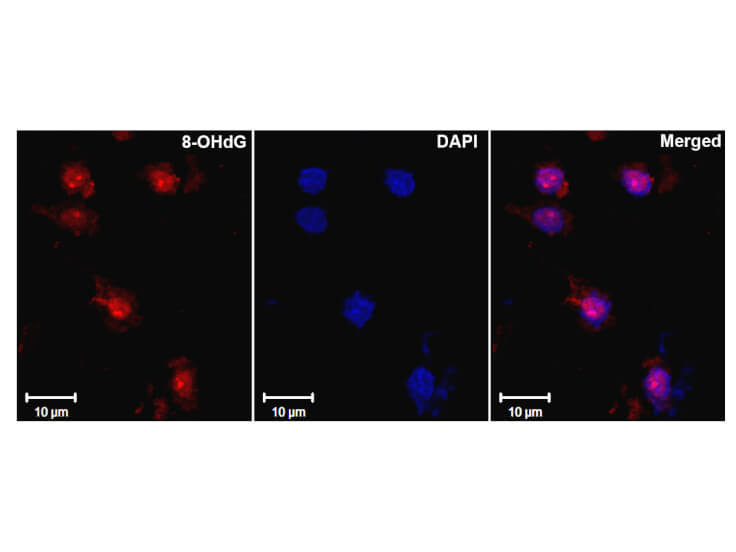
200-301-A99
8-Hydroxy Guanine Antibody

Cannot supply to this region.
- SKU:
- 200-301-A99
- Additional Names:
- 8 hydroxy 2' deoxyguanosine antibody, 8 hydroxyguanine antibody, 8 hydroxyguanosine antibody, 8 OHG antibody, 8-OHG antibody, 8OG antibody, 8OHdG antibody, 8OHG antibody, 8-Hydroxy Guanine Antibody, 8-OH-dG Antibody, DNA/RNA Damage Antibody
- Application:
- ELISA, Flow Cytometry, IHC, WB, IF, IP
- Concentration:
- 1 mg/ml
- Physical State:
- Liquid
- Storage Conditions:
- 2-8[o]C Aliquot. Avoid freeze/thaw cycles. Store undiluted., -20[o]C Aliquot. Avoid freeze/thaw cycles. Store undiluted.
- Supplier:
- Rockland Inc
- Host:
- Mouse
- Reactivities:
- Human, Mouse, Rat
- Buffer:
- 0.01 M Sodium Phosphate, 0.15 M Sodium Chloride
- Immunogen:
- This Protein G purified monoclonal antibody was prepared using conventional hybridoma technology after repeated immunizations with 8-hydroxy-guanosine-BSA and casein conjugates.
- Formulation:
- 0.01 M Sodium Phosphate, 0.15 M Sodium Chloride, pH 7.2
- Clone:
- 15A3
- Extra Details:
- DNA or RNA damage is due to environmental factors and normal metabolic processes inside the cell, that then hinder the ability of the cell to carry out its functions. There are four main types of DNA damage due to endogenous cellular processes: oxidation, alkylation, hydrolysis and mismatch of the bases. During the oxidation of bases, highly reactive chemical entities collectively known as RONS may develop. RONS stands for reactive oxygen and nitrogen species and includes nitric oxide, superoxide, hydroxyl radical, hydrogen peroxide and peroxynitrite. Numerous studies have shown that RONS cause a variety of other issues in addition to DNA damage. 8-hydroxyguanine, 8-hydroxy-2'-deoxyguanosine and 8-hydroxyguanosine are all RNA and DNA markers of oxidative damage. 8-hydroxy-2'-guanosine is produced by reactive oxygen and nitrogen species including hydroxyl radical and peroxynitrite. Specifically its high biological relevance is due to its ability to induce G to T transversions, which is one of the most frequent somatic mutations (2). 8-hydroxy-guanine has been the most frequently studied type of DNA base damage, with studies in diabetes, and cancer. Base modifications of this type arise from radical-induced hydroxylation and cleavage reactions of the purine ring. Finally, 8-hydroxy-guanosine, like 8-hydroxy-2'-guanosine, induces a mutagenic transversion of G to T in DNA. Its role has been tested specifically in the development of diabetes, hypertension and strokes.
- Shipping Conditions:
- Dry Ice