200-301-912
HEF1 Antibody

Cannot supply to this region.
- SKU:
- 200-301-912
- Additional Names:
- mouse anti-hEF1 antibody, mouse anti-NEDD-9 antibody, mouse anti-CASL antibody, Cas like docking antibody, CASL antibody, Crk associated substrate related protein antibody, dJ49G10.2 antibody, dJ761I2.1 antibody, Enhancer of filamentation 1 antibody|NEDD9
- Application:
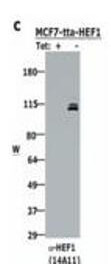
- ELISA, WB, IF, IP
- Concentration:
- 1 mg/ml
- Physical State:
- Liquid
- Species Reactivity:
- Human
- Storage Conditions:
- -20[o]C aliquoted. Aliquot. Avoid freeze/thaw cycles., 2-8[o]C diluted. Aliquot. Avoid freeze/thaw cycles.
- Supplier:
- Rockland Inc
- Host:
- Mouse
- Reactivities:
- Human
- Buffer:
- 0.02 M Potassium Phosphate, 0.15 M Sodium Chloride
- Immunogen:
- Anti-HEF1 monoclonal antibody was produced by repeated immunizations with a synthetic peptide corresponding to amino acid residues 82-398 of human HEF1 protein.
- Formulation:
- 0.02 M Potassium Phosphate, 0.15 M Sodium Chloride, pH 7.2
- Clone:
- 14A11
- Uniprot:
- Q14511
- Synonyms:
- Cas scaffolding protein family member 2;CAS-L;cas-like docking;CAS2;CASL;CASS2;Crk-associated substrate related protein Cas-L;CRK-associated substrate-related protein;enhancer of filamentation 1;Enhancer of filamentation 1 p55;HEF1;neural precursor cell expressed developmentally down-regulated protein 9;p105;p130Cas-related protein;renal carcinoma antigen NY-REN-12
- Extra Details:
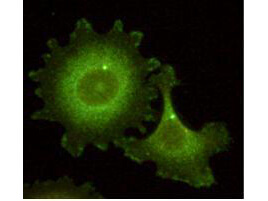
- HEF1, also known as Enhancer of filamentation 1, CRK-associated substrate-related protein, CAS-L, CasL, p105 and Neural precursor cell expressed developmentally down-regulated 9 is the product of the NEDD9 (CASGL) gene. HEF1 functions as a docking protein that plays a central coordinating role for tyrosine-kinase-based signaling related to cell adhesion. HEF1 may also function in transmitting growth control signals between focal adhesions at the cell periphery and the mitotic spindle in response to adhesion or growth factor signals initiating cell proliferation. HEF1 may also play an important role in integrin beta-1 or B cell antigen receptor (BCR) mediated signaling in B- and T-cells. Integrin beta-1 stimulation leads to recruitment of various proteins including CRK, NCK and SHPTP2 to the tyrosine phosphorylated form. HEF1 forms a homodimer and can heterodimerize with HLH proteins ID2, E12, E47 and also with p130cas. HEF1 also forms complexes in vivo with related adhesion focal tyrosine kinase (RAFTK), adapter protein CRKL and LYN kinase and also interacts with MICAL and TXNL4/DIM1. This protein localizes to both the cell nucleus and the cell periphery and is differently localized in fibroblasts and epithelial cells. In fibroblasts is predominantly nuclear and in some cells is present in the Golgi apparatus. In epithelial cells localized predominantly in the cell periphery with particular concentration in lamellipodia but is also found in the nucleus. HEF1 is widely expressed although higher levels are detected in kidney, lung, and placental tissue. HEF1 is also detected in T-cells, B-cells and diverse cell lines. HEF1 is activated upon induction of cell growth. Cell cycle-regulated processing produces four isoforms: p115, p105, p65, and p55. Isoform p115 arises from p105 phosphorylation and appears later in the cell cycle. Isoform p55 arises from p105 as a result of cleavage at a caspase cleavage-related site and it appears specifically at mitosis. The p65 isoform is poorly detects. Isoforms p105 and p115 are predominantly cytoplasmic and associate with focal adhesions while p55 associate with the mitosis spindle.
- Shipping Conditions:
- Dry Ice