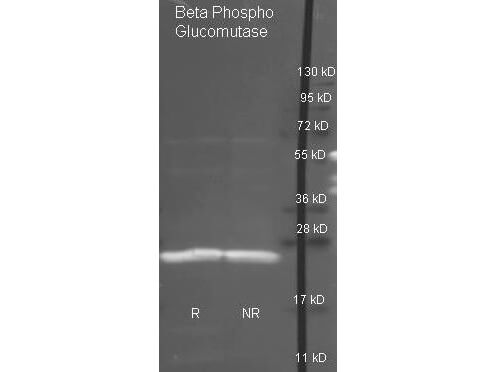
200-101-237S
Beta-Phosphoglucomutase Antibody

Cannot supply to this region.
- SKU:
- 200-101-237S
- Additional Names:
- goat anti-Beta-Phosphoglucomutase Antibody, goat anti-Beta PGM antibody, Glucose phosphomutase 1 antibody, Glucose phosphomutase antibody, PGM antibody, pgmB antibody|pgmB
- Application:
- ELISA, WB
- Concentration:
- 1 mg/ml
- Physical State:
- Liquid
- Species Reactivity:
- Bacteria
- Storage Conditions:
- -20[o]C diluted. Avoid freeze/thaw cycles., See Manual Avoid freeze/thaw cycles.
- Supplier:
- Rockland Inc
- Host:
- Goat
- Reactivities:
- Bacteria
- Buffer:
- 0.02 M Potassium Phosphate, 0.15 M Sodium Chloride
- Immunogen:
- Beta Phosphoglucomutase [Lactococcus lacti]
- Formulation:
- 0.02 M Potassium Phosphate, 0.15 M Sodium Chloride, pH 7.2
- Uniprot:
- P71447
- Synonyms:
- L0001
- Extra Details:
- Beta-Phosphoglucomutase catalyzes the interconversion of D-glucose 1-phosphate (G1P) and D-glucose 6-phosphate (G6P), forming beta-D-glucose 1,6-(bis)phosphate (beta-G16P) as an intermediate. The beta-phosphoglucomutase (Beta-PGM) acts on the beta-C1 anomer of G1P. Glucose or lactose are used in preference to maltose, which is only utilized after glucose or lactose has been exhausted. It plays a key role in the regulation of the flow of carbohydrate intermediates in glycolysis and the formation of the sugar nucleotide UDP-glucose. The catalysis proceeds via a phosphoenzyme formed by reaction of an active-site nucleophile with the cofactor glucose 1,6-diphosphate (G1,6-diP). The phosphorylated mutase binds either G1P or G6P and transfers the phosphoryl group to the C6OH or C1OH, respectively.
- Shipping Conditions:
- Dry Ice