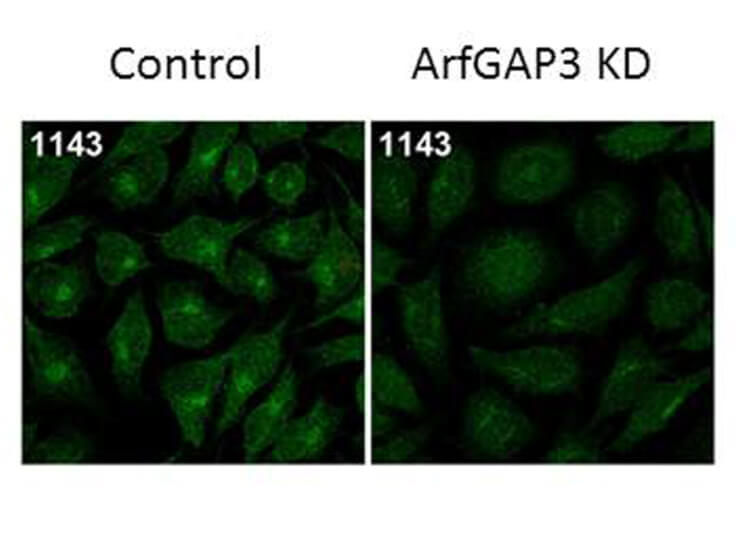
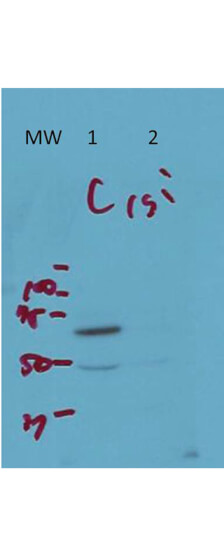
100-401-H46S
ARFGAP3 Antibody

Cannot supply to this region.
- SKU:
- 100-401-H46S
- Additional Names:
- ARFGAP3|rabbit anti-ArfGAP3 Antibody, ARFGAP1, ADP-ribosylation factor GTPase-activating protein 3, ARF GAP3, Arf-GAP, ArfGAP
- Application:
- ELISA, WB, IF, IP
- Concentration:
- 70 mg/ml
- Physical State:
- Liquid
- Species Reactivity:
- Human
- Storage Conditions:
- -20[o]C diluted. Avoid freeze/thaw cycles., See Manual Avoid freeze/thaw cycles.
- Supplier:
- Rockland Inc
- Host:
- Rabbit
- Reactivities:
- Human
- Buffer:
- 0.02 M Potassium Phosphate, 0.15 M Sodium Chloride
- Immunogen:
- This whole rabbit serum was prepared by repeated immunizations with a truncated recombinant sequence of ArfGAP3 fused to GST.
- Formulation:
- 0.02 M Potassium Phosphate, 0.15 M Sodium Chloride, pH 7.2
- Format:
- Antiserum
- Uniprot:
- Q9NP61
- Synonyms:
- ADP-ribosylation factor GTPase activating protein 1;ADP-ribosylation factor GTPase-activating protein 3;ARF GAP 3;ARFGAP1
- Extra Details:
- This antibody is designed, produced, and validated as part of a collaboration between Rockland and the National Cancer Institute (NCI) and is suitable for Cancer, Immunology and Nuclear Signaling research. The ArfGAPs are a family of proteins encoded by 31 genes in humans. The function of the ArfGAPs is to regulate the small G protein Arf, a regulator of membrane traffic and actin cytoskeleton. The ArfGAPs have been found to be key regulators of cellular behaviors that involve coordinated actin and membrane remodeling, including protein secretion and migration. Several ArfGAPs are associated with cancer cell invasion and metastasis, and the Arf pathway has been found to be affected in a number of genetic diseases. Although the importance of the ArfGAPs and the Arf pathway for cellular physiology is well recognized, the molecular basis for the function of these proteins has not been established. Reagents for the studies, especially antibodies specific for particular members of the ArfGAP family that can be used for immunoblotting and immunofluorescence, are not available. ArfGAP3 is one of three ArfGAPs thought to be specifically associated with the Golgi apparatus; however, localization has only been done for ectopically expressed recombinant protein and cellular function is still not established. Indeed, there is a growing controversy about the function of ArfGAP3 together with ArfGAP1 and ArfGAP2. Antibodies suitable for immunoprecipitation, immunoblotting and immunofluorescence would be of great value in addressing the controversy and for discovering the potential role of ArfGAP3 in secretion of proteins, such as growth factors, and trafficking of other proteins to the cell surface, such as growth factor receptors and cell adhesion molecules.
- Shipping Conditions:
- Dry Ice