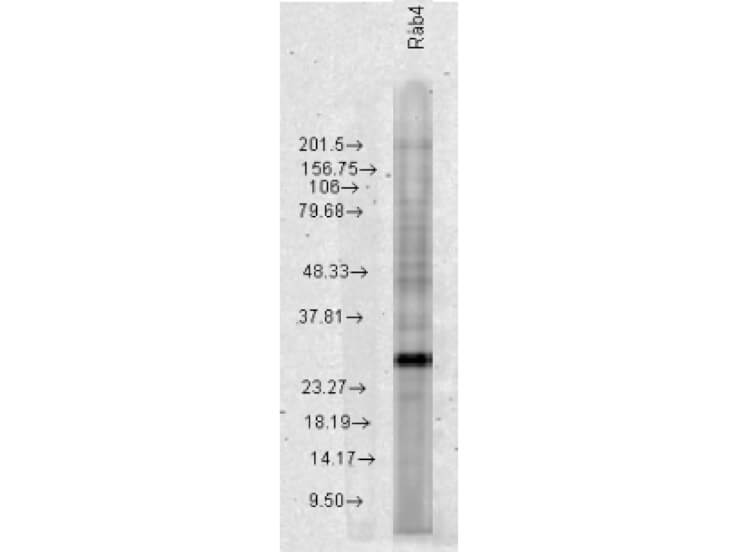
100-401-G35
RAB4 Antibody

Cannot supply to this region.
- SKU:
- 100-401-G35
- Additional Names:
- Oncogene Rab4, Rab4A, Ras related protein Rab-4A|RAB4A
- Application:
- IHC, WB, IF
- Concentration:
- 85 mg/ml
- Physical State:
- Liquid
- Species Reactivity:
- Human
- Storage Conditions:
- -20[o]C aliquoted. Aliquot. Avoid freeze/thaw cycles., 2-8[o]C diluted. Aliquot. Avoid freeze/thaw cycles.
- Supplier:
- Rockland Inc
- Host:
- Rabbit
- Reactivities:
- Human, Mouse, Rat
- Buffer:
- 0.02 M Potassium Phosphate, 0.15 M Sodium Chloride
- Immunogen:
- Rab4 Antibody was produced from whole rabbit serum prepared by repeated immunizations raised against a C-terminal region synthetic peptide from human Rab4.
- Formulation:
- 0.02 M Potassium Phosphate, 0.15 M Sodium Chloride, pH 7.2
- Format:
- Antiserum
- Uniprot:
- P20338
- Synonyms:
- HRES-1;HRES-1/RAB4;HRES1;HTLV-1 related endogenous sequence;RAB4;ras-related protein Rab-4A
- Extra Details:
- Rab4 is a 25kDa member of the Rab family of small guanosine triphosphatases (GTPases), Ras superfamily. Rab GTPases are central regulators of membrane trafficking in the eukaryotic cell. Their regulatory capacity depends on their ability to cycle between the GDP -bound inactive and GTP-bound active states. This conversion is regulated by GDP/GTP exchange factors (GEPs), GDP dissociation inhibitors (GDIs) and GTPase-activating proteins (GAPs). Activation of a Rab protein is coupled to its association with intracellular membranes, allowing it to recruit downstream effector proteins to the cytoplasmic surface of a sub-cellular compartment. Through these proteins, Rab GTPases regulate vesicle formation, actin- and tubulin-dependent vesicle movement, and membrane fusion. Rab proteins contain conserved regions involved in guanine-nucleotide binding, and hyper-variable COOH-terminal domains with a cysteine motif implicated in sub-cellular targeting. Post-translational modification of the cysteine motif with one or two geranylgeranyl groups is essential for the membrane association and correct intracellular localization of Rab proteins. Each Rab shows a characteristic sub-cellular distribution. In particular, over-expression of Rab4 causes a redistribution of receptors on plasma membrane versus endocytic compartments. The presence of excessive Rab4 leads to the accumulation of transferrin receptors in non-acidic, post-endosomal recycling vesicles considered an intermediate compartment between endosomes and plasma membranes. Rab4 also plays a role in the translocation of glucose transporter (Glu4) in adipocytes in response to insulin. Mediating the association of Rab4 with transferring receptor-containing early endosomes takes place through the geranylgeranyl groups at its carboxyl-terminus. Membrane association is also cell cycle dependent, as phosphorylation at its c-terminal cdc2 kinase consensus sequence in mitotic cells leads to dissociation of Rab4 into the cytosol.
- Shipping Conditions:
- Dry Ice