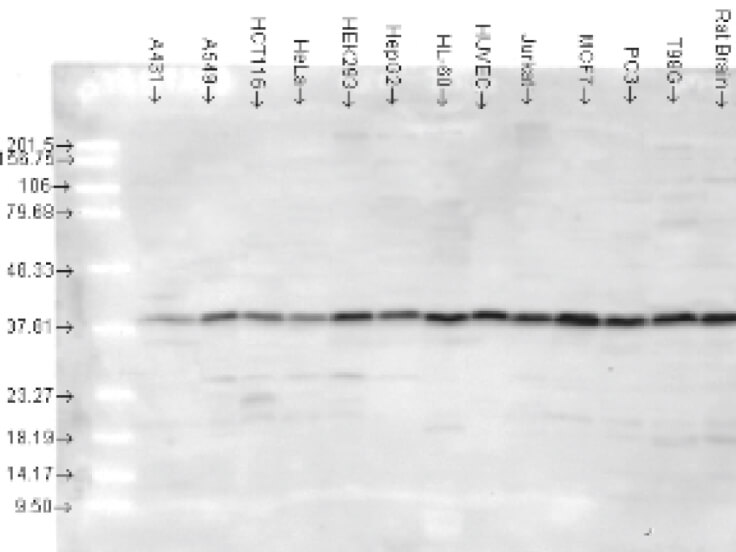
100-401-G26
p38 Antibody

Cannot supply to this region.
- SKU:
- 100-401-G26
- Additional Names:
- CSAID Binding protein 1, CSBP1, CSBP2, EXIP, MAPkinase p38alpha, MAPK14, p38 ALPHA, p38 MAP kinase, p38 mitogen activated protein kinase, RK, SAPK 2A, Stress activated protein kinase 2A, 39S ribosomal protein L23, mitochondrial, L23 mitochondrial-related protein, Mitogen-activated protein kinase 14, MAP kinase 14, MAPK 14, Cytokine suppressive anti-inflammatory drug-binding protein, CSBP, MAP kinase MXI2, MAX-interacting protein 2, Mitogen-activated protein kinase p38 alpha, MAP kinase p38
- Application:
- IHC, WB, IF, IP
- Concentration:
- 1 mg/ml
- Physical State:
- Liquid
- Species Reactivity:
- Human
- Storage Conditions:
- -20[o]C aliquoted. Aliquot. Avoid freeze/thaw cycles., 2-8[o]C diluted. Aliquot. Avoid freeze/thaw cycles.
- Supplier:
- Rockland Inc
- Host:
- Rabbit
- Reactivities:
- Bovine, Canine, Hamster, Human, Mouse, Porcine, Rabbit, Rat, Guinea Pig, Ovine
- Buffer:
- 0.02 M Potassium Phosphate, 0.15 M Sodium Chloride
- Immunogen:
- p38 Antibody was produced from whole rabbit serum prepared by repeated immunizations raised against a 20 residue synthetic peptide based on the human p38 with the cysteine residue added and coupled to KLH.
- Formulation:
- 0.02 M Potassium Phosphate, 0.15 M Sodium Chloride, pH 7.2
- Format:
- Antiserum
- Uniprot:
- Q16539
- Synonyms:
- CSAID-binding protein;CSBP;CSBP1;CSBP2;CSPB1;cytokine suppressive anti-inflammatory drug binding protein;Cytokine suppressive anti-inflammatory drug-binding protein;EXIP;MAP kinase 14;MAP kinase Mxi2;MAP kinase p38 alpha;MAX-interacting protein 2;mitogen-activated protein kinase 14;mitogen-activated protein kinase p38 alpha;Mxi2;p38;p38 MAP kinase;p38 mitogen activated protein kinase;p38ALPHA;p38alpha Exip;PRKM14;PRKM15;RK;SAPK2A;stress-activated protein kinase 2A
- Extra Details:
- The MAPK (mitogen activated protein kinase) comprises a family of ubiquitous praline-directed, protein-serine/threonine kinases which signal transduction pathways that control intracellular events including acute responses to hormones and major developmental changes in organisms. This super family consists of stress activated protein kinases (SAPKs); extracellular signal-regulated kinases (ERKs); and p38 kinases, each of which forms a separate pathway. The kinase members that populate each pathway are sequentially activated by phosphorylation. Upon activation, p38 MAPK/SAPK2A Alpha translocates into the nucleus where it phosphorylates one or more nuclear substrates, effecting transcriptional changes and other cellular processes involved in cell growth, division, differentiation, inflammation, and death. Specifically p38 always acts as a pro-apoptotic factor with its activation leading to the release of cytochrome c from mitochondria and cleavage of caspase 3 and its downstream effector, PARP. p38 MAPK is activated by a variety of chemical stress inducers including hydrogen peroxide, heavy metals, anisomycin, sodium salicylate, LPS, and biological stress signals such as tumor necrosis factor, interleukin-1, ionizing and UV irradiation, hyperosmotic stress and chemotherapeutic drugs. As a result, p38 alpha has been widely validated as a target for inflammatory disease including rheumatoid arthritis, COPD and psoriasis and has also been implicated in cancer, CNS and diabetes.
- Shipping Conditions:
- Dry Ice