
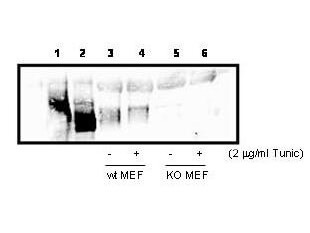
100-401-962
PERK Antibody

Cannot supply to this region.
- SKU:
- 100-401-962
- Additional Names:
- Eif2ak3|rabbit anti-PKR-like Endoplasmic Reticulum Kinase Antibody, rabbit anti-PERK Antibody, PKR-like endoplasmic reticulum kinase, PERK, Eukaryotic translation initiation factor 2-alpha kinase 3
- Application:
- ELISA, IHC, WB, IF, IP
- Concentration:
- 80 mg/ml
- Physical State:
- Liquid
- Species Reactivity:
- Mouse
- Storage Conditions:
- -20[o]C aliquoted. Aliquot. Avoid freeze/thaw cycles., 2-8[o]C diluted. Aliquot. Avoid freeze/thaw cycles.
- Supplier:
- Rockland Inc
- Host:
- Rabbit
- Reactivities:
- Mouse
- Buffer:
- 0.02 M Potassium Phosphate, 0.15 M Sodium Chloride
- Immunogen:
- This whole rabbit serum was prepared by repeated immunizations with a recombinant fusion protein from amino acids 601-1115 of mouse deltaN PERK.
- Formulation:
- 0.02 M Potassium Phosphate, 0.15 M Sodium Chloride, pH 7.2
- Format:
- Antiserum
- Uniprot:
- Q9Z2B5
- Synonyms:
- eukaryotic translation initiation factor 2-alpha kinase 3;pancreatic eIF2-alpha kinase;PE;Pek;Perk;PRKR-like endoplasmic reticulum kinase
- Extra Details:
- The PKR-like endoplasmic reticulum kinase (PERK, also know as Eukaryotic translation initiation factor 2-alpha kinase 3) is a type I transmembrane protein localized to the endoplasmic reticulum (ER). PERK consists of an N-terminal ER luminal domain, a membrane-spanning region, and a cytosolic C-terminal serine/threonine kinase domain (1). The luminal domain of PERK is bound to the ER chaperone GRP78 in unstressed cells (2). PERK activation occurs upon accumulation of misfolded proteins and the ER lumen, which triggers GRP78 dissociation from PERK thereby allowing PERK dimerization and autophosphorylation (3, 4). PERK phosphorylates two established targets: the eukaryotic translation initiation factor 2 alpha (eIF2, (1)) and the Nrf2 transcription factor (5). Phosphorylation of eIF2 results in attenuation of translation initiation (6). The translational block also contributes to cell cycle arrest due to loss of the G1 regulatory protein, cyclin D1 (7). PERK-dependent phosphorylation of Nrf2 promotes transcription of phase II detoxifying enzymes which is critically important for elimination of intracellular reactive oxygen species (8). Thus, while inhibiting new protein synthesis and thereby decreasing the ER protein load PERK simultaneously induces expression of genes that help restore cellular redox homeostasis and promote survival.
- Shipping Conditions:
- Dry Ice