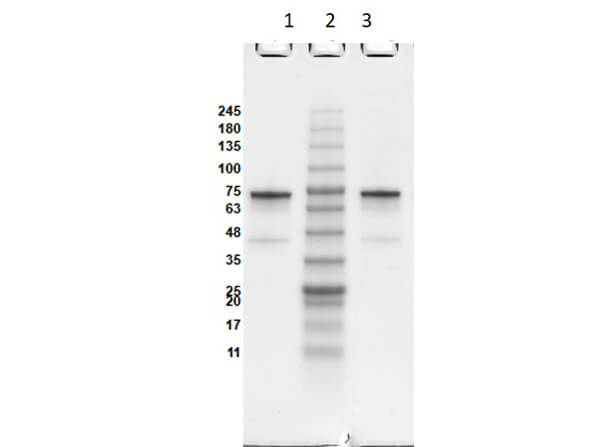
000-001-C15
OspB Control Protein

Cannot supply to this region.
- SKU:
- 000-001-C15
- Additional Names:
- ospB, locus BB_A16|Outer surface protein B, Borrelia burgdorferi OspB, control protein
- Application:
- ELISA, SDS-PAGE, WB, Functional Assay
- Concentration:
- 1 mg/ml
- Physical State:
- Liquid
- Purity:
- >90%
- Storage Conditions:
- Please refer to datasheet
- Supplier:
- Rockland Inc
- Buffer:
- 0.02 M Potassium Phosphate, 0.15 M Sodium Chloride
- Immunogen:
- ospB, locus BB_A16
- Formulation:
- 0.02 M Potassium Phosphate, 0.15 M Sodium Chloride, pH 7.2
- Species:
- Bacteria
- Uniprot:
- P17739
- Synonyms:
- BB_A16;BB_RS05185;outer surface lipoprotein OspB
- Extra Details:
- OspB, is one of the major Outer Surface Proteins of the outer membrane of Borrelia burgdorferi, which is composed of various unique outer surface proteins (Osp) that have been characterized (OspA through OspF). The Osp proteins are lipoproteins anchored by N-terminally attached fatty acid molecules to the membrane. They are presumed to play a role in virulence, transmission, or survival in the tick. Two of the major surface Ag of Borrelia burgdorferi, the 31-kDa OspA and 34-kDa OspB proteins, show a high degree of sequence similarity, are encoded by a 49-kb plasmid and share a common promoter, and are coordinately transcribed. OspA, OspB, and OspD are expressed by B. burgdorferi residing in the gut of unfed ticks, suggesting that they promote the persistence of the spirochete in ticks between blood meals. OspB has a contributing role in the adherence of B. burgdorferi to the tick gut. The C terminus of OspB is important for eliciting a protective immune response to OspB. B. burgdorferi has the ability to vary its surface proteins in response to immune attack. Lyme disease proteins are ideal for researchers interested in immunology, neurology, rheumatology, coinfections, autoimmune, and neurodegenerative diseases.
- Shipping Conditions:
- Dry Ice