000-001-C14
Flagellin Control Protein

Cannot supply to this region.
- SKU:
- 000-001-C14
- Additional Names:
- 41 kDa antigen, Borrelia burgdorferi p41, fla, Flagellar filament 41 kDa core protein, Bacterial flagellin, control protein|BBU94A_0149, fla
- Application:
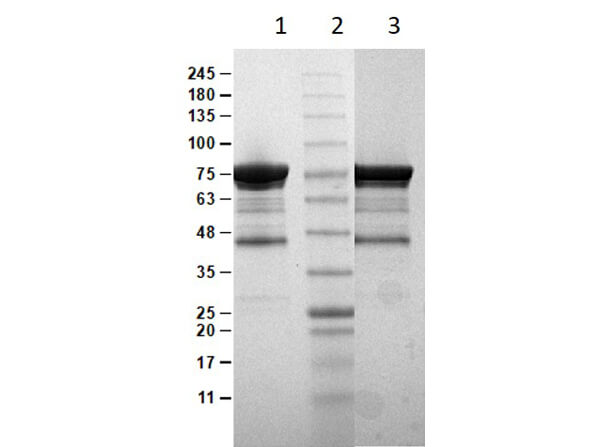
- ELISA, SDS-PAGE, WB, Functional Assay
- Concentration:
- 1 mg/ml
- Physical State:
- Liquid
- Purity:
- >90%
- Storage Conditions:
- Please refer to datasheet
- Supplier:
- Rockland Inc
- Buffer:
- 0.02 M Potassium Phosphate, 0.15 M Sodium Chloride
- Immunogen:
- BBU94A_0149, fla
- Formulation:
- 0.02 M Potassium Phosphate, 0.15 M Sodium Chloride, pH 7.2
- Species:
- Bacteria
- Uniprot:
- P11089
- Synonyms:
- 41 kDa antigen;BB_0147;BB_RS00725;BbuZS7_0147;flagellin FlaB;P41
- Extra Details:
- Flagellin is a protein found in the hollow cylinder forming the filament in bacterial flagellum. Its structure is helical, which is important for its function. Studies comparing a flagellate Borrelia to flagellated indicate that the flagella have a role in the invasion of human tissue. The N- and C-termini of flagellin form the inner core of the flagellar filament, and the central portion of the protein makes up the outer surface. While the terminus of the protein is quite similar between all bacterial flagellins, the central portion is variable. The flagellin genes are highly conserved among the different Borrelia species. Mammals often have acquired immune responses (T-cell and antibody responses) to flagellated bacterium. Some bacteria are able to switch between multiple flagellin genes in order to evade this response. Borrelia burgdorferi, the spirochete that is associated with Lyme Disease, may use this tactic when challenging mammals with infection. Borrelia have double-stranded linear plasmids in addition to supercoiled circular plasmids, in low copy number. This suggests that initiation of DNA replication and partitioning are carefully controlled during the cell division cycle. It is believed that expression of the various proteins associated with the spirochete may be regulated by the changes in tick life cycle, changes in conditions during tick feeding (such as temperature, pH, and nutrients) and/or in coordination with the course of infection of the mammal host, i.e., changes in environment as the spirochete migrates from the tick's midgut to its salivary glands to the mammal host. B. burgdorferi can attach to (and also differentially express antigens in) diverse tissues within the vertebrate host and the tick vector, suggesting that physiological factors other than pH and temperature may play roles in modulating B. burgdorferi gene expression. Lyme disease proteins are ideal for researchers interested in immunology, neurology, rheumatology, coinfections, autoimmune, and neurodegenerative diseases.
- Shipping Conditions:
- Dry Ice